· 7 min read
AWS Says the Big AI Capacity Blocks Are Spoken For. That's Not the Same as a Sold-Out Cloud.
Amazon says its biggest cloud-capacity blocks are booked far ahead. The more useful question is how reservations translate into real chips, available services and returns.
By TAP Desk
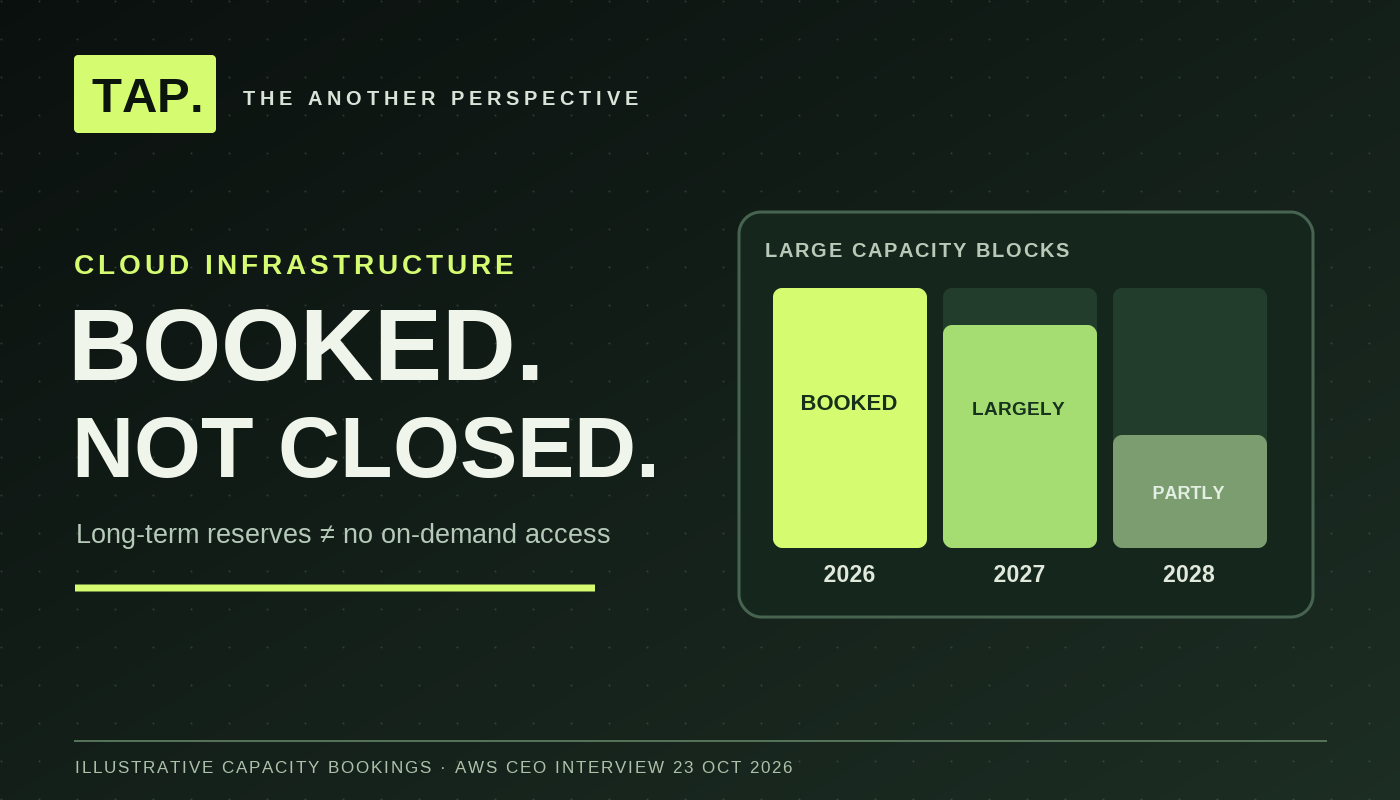
Diagram depicts Amazon CEO Andy Jassy’s October 23 booking claims, not independently audited capacity. Conceptual shapes; on-demand services remain available. · TAP original editorial artwork
Amazon says significant chunks of its cloud future have already been sold. In an October 23 interview on the a16z Show, chief executive Andy Jassy said major AWS capacity commitments covered 2026, much of 2027 and part of 2028. It sounds as though the cloud has reached a physical ceiling. Yet AWS still offers on-demand services, and the headline is not proof that every customer is shut out.
The more useful interpretation is that some customers are booking expensive computing capacity years ahead, while Amazon faces real constraints in supplying it. For businesses that rely on the cloud, that is not only an Amazon story. It raises questions about who gets priority, what advance commitments mean and how much money a platform must risk before the equipment earns a return.
What 'sold out' actually means
Jassy's statements were about the large blocks of capacity customers want to reserve. He said 2026 was sold out for those blocks and 2027 largely sold out, while a good chunk of 2028 was spoken for. The distinction between large negotiated reservations and capacity available on demand matters. In the same account, Jassy said Amazon preserves some resources for users of services such as EC2 and its Bedrock AI platform.
That is why a headline announcing that AWS is 'sold out until 2028' goes too far. It can imply that no one can start a server or run a model without a multiyear deal. Amazon did not say that. The claim also concerns management's description of customer commitments; it is not an independently audited record of installed machines, signed contract values or actual service availability in every region.
For organizations considering cloud providers, the questions are more granular: which processor or service is constrained, in which location, at what date and under what contractual terms? A commitment to future infrastructure has different economics from equipment that has been commissioned and is billing customers today.
AI capacity is not simply a warehouse of chips
One way to misunderstand the buildout is to imagine Amazon can answer demand by placing an order for more graphics processors. Large AI clusters also require power delivery, cooling, physical space, networking, testing and people who can operate them. Several of those inputs have schedules that are not controlled by an application developer or even a cloud provider.
Industry reporting following Jassy's interview highlighted memory and other component bottlenecks, and a division of demand between conventional cloud workloads and AI. When inputs arrive at different speeds, an expensive building can be ready before the networking or computing equipment it needs. A useful capacity measure must therefore distinguish announced construction, installed machines, available compute and fulfilled customer contracts.
That sequencing creates an infrastructure management problem. A supplier wants to reserve enough inputs to satisfy large AI labs without starving customers running stores, bank systems or enterprise software. It also has to decide how much spare capacity to keep available for users who cannot promise years of demand in advance.
Why the $220 billion spending figure needs context
Jassy discussed Amazon's approximately $220 billion capital-spending plan for 2026 as evidence of the scale of investment needed to meet demand. That is an Amazon-wide plan, not a verified bill for AI chips alone. Cloud data centers are a large part of the pressure, but Amazon invests in other facilities, equipment and operations as well.
A commitment to spend is also different from demonstrated profitability. Installing more machines can increase sales capacity, but returns depend on how often customers use them, what they pay and whether hardware remains competitive over the life of the investment. AI processing costs can fall with new chips and efficiency gains, changing the economics of long-term reservations.
The investment dilemma cuts both ways. A provider that waits for demand to become fully certain may lose customers because it cannot supply them. One that builds too early may own expensive, underused infrastructure. The company has to manage that timing, not simply maximize the number of reservations it announces.
The question for customers who cannot prebook years ahead
Major model developers and large enterprises can negotiate large capacity packages because their intended workloads are enormous. Smaller companies often need flexibility more than they need a dedicated cluster. That difference may widen the gap between firms able to purchase predictable computing access and firms exposed to the availability and pricing of shared services.
Nothing in Jassy's comments proves smaller organizations will be systematically excluded, and Amazon says it retains some on-demand capacity. But the pressure makes transparency around regional availability, service quotas, wait times and price changes increasingly important. Even customers with little direct interest in AI can be affected when infrastructure becomes the shared input for an expanding range of industries.
The answer may not be a single cheaper server. Businesses can reduce dependence on one expensive chip type, use models requiring less computation and make workloads portable between providers where feasible. Those decisions involve their own engineering and governance costs, but they make capacity risk visible before an outage or price increase exposes it.
The TAP perspective: bookings are promises, not completed supply
Customers reserving 2028 computing capacity are expressing an expectation about their future workloads. Providers investing in that future must translate those expectations into electricity, data centers, chips and eventually customer invoices. The calendar is longer and the investment is harder to reverse than a subscription decision made in a software dashboard.
The statistic to watch next is not only how far ahead AWS says large blocks are committed. It is what actually goes live, the portion customers use, the mix of reserved and on-demand services, and whether revenue can support the buildout. Those measures help distinguish a sustainable infrastructure business from a cycle of increasingly impressive advance commitments.
For now, the narrower statement is the accurate one: Amazon says major customer reservations stretch far into 2028, while AWS preserves some on-demand access. That is a striking sign of pressure in the market for computing power. It is not the same thing as saying the cloud has closed its doors.