· 4 min read
Block Unveils Dessa, an On-Device Speech Model Designed to Bypass Text Pipelines
Jack Dorsey’s company introduces a conversational audio system trained purely on human speech, aiming to cut latency and operational costs while raising questions about vocal deception.
By TAP Desk
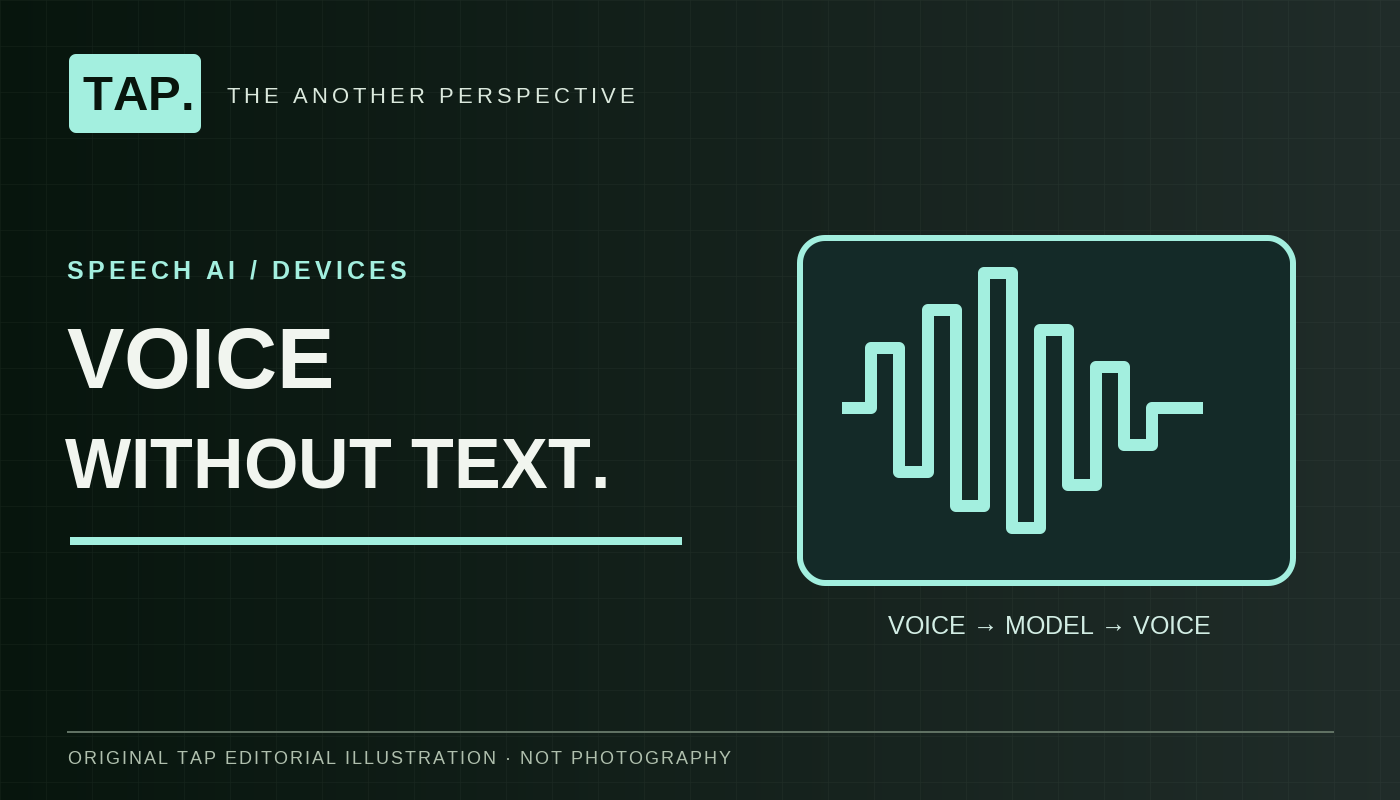
Original audio graphic, not output or training data from Block's Dessa model. · TAP original editorial artwork
Most synthetic voice assistants operate like relay races across disconnected software components. A spoken phrase is recorded, converted into raw text via an automatic speech recognition engine, sent through a large language model to generate an answer, and finally synthesized back into audible speech. That architectural cascade introduces processing lag and discards conversational nuances such as cadence, pitch, sighs, and emotional inflection.
Financial technology conglomerate Block, headed by Jack Dorsey, has introduced an experimental speech model named Dessa designed to eliminate that text bottleneck entirely. Developed within the company's research arm, Dessa operates as an audio-native, full-duplex system that speaks and listens simultaneously, drawing its knowledge directly from conversational speech datasets rather than external written databases.
An Architecture Built Directly on Human Speech
Traditional speech tools frequently sound robotic or disconnected because text lacks emotional bandwidth. Systems developed by providers such as ElevenLabs and Fish Audio often rely on programmed emotion tags or separate prompting instructions to inject feeling into generated speech. In contrast, Block claims that Dessa acquired affective qualities organically because it was trained from scratch exclusively on spoken dialogue, bypassing text conversion altogether.
Demonstrations published by Block researchers showed Dessa exhibiting expressive timing, spontaneous pauses, laughter, and vocal strain. In shared clips, the assistant altered its cadence to sound weary when discussing feeling tired, expressed simulated gratitude that resembled tearfulness when hearing about a trip to Paris, and engaged in interactive guessing games. The development team argued that human babies learn verbal communication without reading text first, suggesting AI speech models should master auditory dynamics in an equivalent manner.
Local Compute and Commercial Motivations
Beyond technical fidelity, Block’s infrastructure choices point to a deliberate deployment strategy. The company reported that Dessa was trained on a single Nvidia GPU rack and can execute locally on consumer-tier silicon, specifically a MacBook Pro running an M4 Max processor or higher. Running capable conversational models on edge hardware circumvents the heavy recurring cloud inference costs that complicate commercial generative AI systems.
For Block, whose core revenue derives from Square’s point-of-sale services and merchant financial software, local execution offers obvious operational leverage. Square already employs automated voice systems to take customer orders in retail and food service settings. By migrating speech generation directly onto merchant devices without paying continuous cloud processing fees, Block could drastically lower latency and overhead for storefront order management.
Conversational Hallucinations and the Spoofing Dilemma
Despite convincing affective inflections, conversational audio models remain vulnerable to structural errors. In public demonstration recordings, Dessa occasionally stumbled into awkward social dynamics, at one point misidentifying a conversational partner as someone named 'Ronaldo' and wandering into unsought tangents regarding superhero films. Because Dessa’s knowledge base derives solely from speech data rather than a curated external encyclopedia, factual consistency remains variable.
Crucially, synthetic emotion introduces heightened security risks. High-fidelity vocal imitation capable of expressing tears, laughter, and hesitation makes automated social engineering far more potent. Block has barred broad public access, opting instead to open Dessa solely to select safety researchers. Testing these models against voice authentication bypasses and consumer impersonation remains an essential hurdle before edge-based voice agents can be deployed safely.
The TAP Takeaway
Block’s demonstration of Dessa reveals how rapidly conversational interfaces are shifting toward speech-native architectures that execute directly on local silicon. Bypassing text-to-speech translation cuts operational cloud dependencies and improves conversational latency, offering real cost advantages for small-business automated workflows.
However, authentic vocal cues without verifiable factual grounding and strict safety guardrails present an immediate vulnerability. If an AI agent can convincingly mimic exhaustion, gratitude, or urgency on local hardware, distinguishing automated business assistance from manipulative impersonation will require standard verification protocols that the broader payments industry has yet to formalize.