· 5 min read
CERN and Mistral Want One AI Model for Physics. Proving It Works Is the Hard Part.
CERN and Mistral plan a model trained on simulated collisions. The significant question is how it will be tested against real detector data.

Photograph of the CMS experiment at CERN. It does not show a completed Mistral AI model or evidence of its scientific performance. · Antonio Vivace / Unsplash
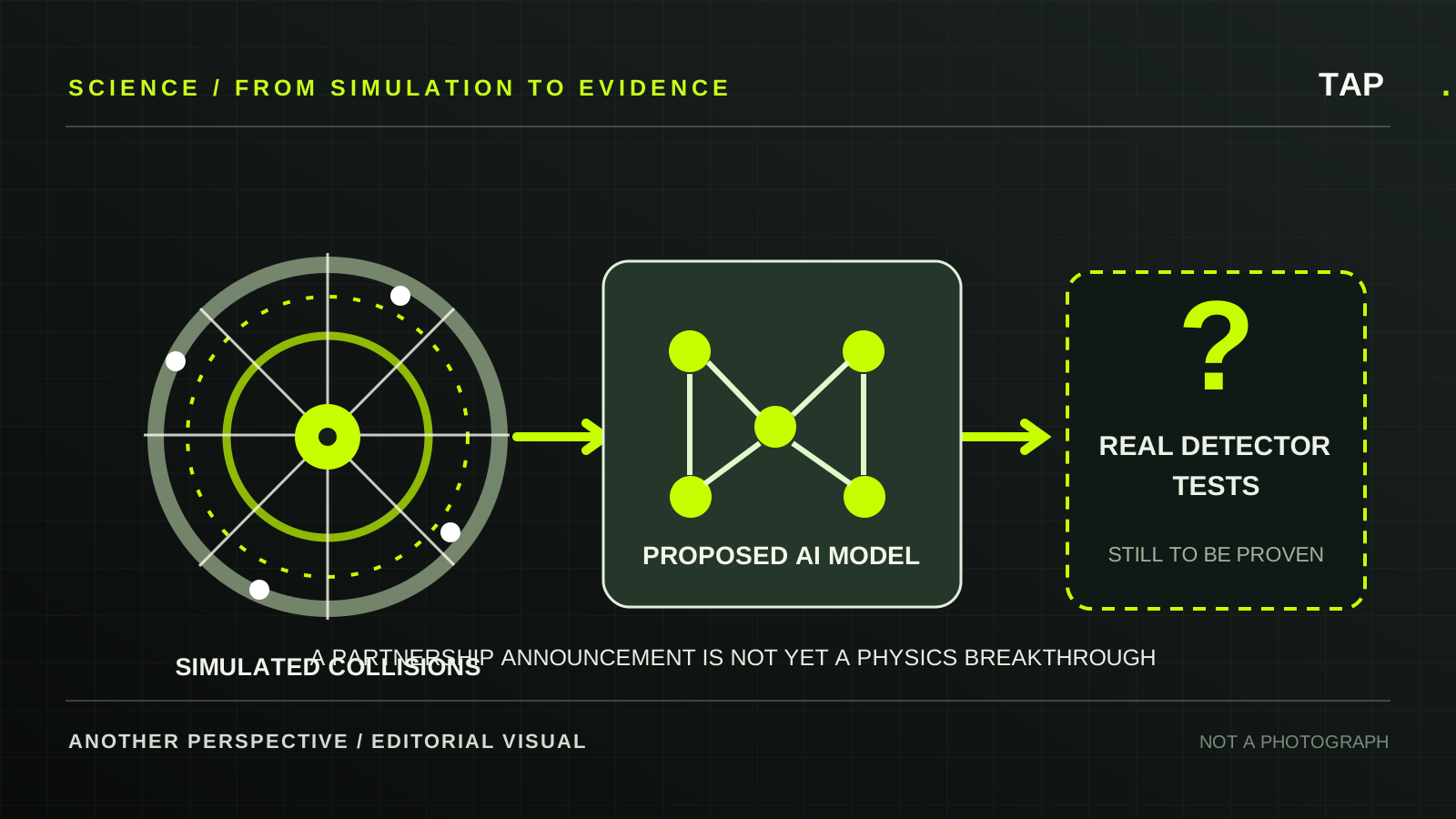
CERN and French AI developer Mistral announced on October 15 that they intend to build a foundation model for particle physics. It is a striking idea: train a general-purpose system on simulated proton collisions so researchers can apply its learned patterns to several analysis tasks rather than writing an entirely separate algorithm for each one. The organisations have signed a statement of intent, not announced a completed model.
The appeal is easy to understand even outside physics. Researchers are already confronted with enormous quantities of detector information. If a shared model can reduce repetitive processing while preserving scientific reliability, it could become useful infrastructure. But processing more data is not the same as making a trustworthy discovery.
A foundation model built for collisions, not conversations
The proposed Large Physics Model would learn from billions of simulated proton-proton collisions. CERN lists possible tasks including particle identification, event reconstruction, finding unusual signals and helping evaluate future detector designs. Those are research goals. The partners have not demonstrated that one released model reliably handles all of them.
Today, particle analysis involves many calibrated stages that translate raw detector readings into quantities physicists can study. A broad model could integrate information across those stages. It could also make troubleshooting harder if a single opaque system produces an error that formerly could be isolated to a specialist component. This is an engineering trade-off, not proof that the proposed system is inferior.
· TAP original editorial artwork
One exabyte is context, not a training result
CERN reports that LHC experiments have accumulated around one exabyte of experimental data. That describes the scale of the laboratory's archive; it does not mean a finished AI model has been trained on all those experimental records. The announced training concept specifically involves simulated collision events.
The High-Luminosity LHC upgrade is expected to raise collision volumes substantially around 2030. That prospect helps explain the motivation for investigating reusable AI systems now. It does not establish the cost of building the model, its eventual accuracy, or an operating timetable.
What a convincing physics benchmark would require
The first evaluation should ask whether the model maintains accuracy on real detector measurements, where noise, calibration differences and unexpected conditions cannot always be captured by simulation. Developers would also need to document failure cases, uncertainty estimates and performance across different particle signatures. Those tests matter more than the number of parameters in the system.
A useful comparison would measure a new model against the established sequence of specialist algorithms on the same data and with clearly declared acceptance criteria. Speed alone would not be sufficient. In particle physics, an efficient method that introduces hard-to-detect biases can undermine a much larger scientific effort.
The TAP perspective: announce the promise, then measure it
Independent reporting by Clubic describes the proposed system as an attempt to make multiple collider-analysis tasks work together. That is an understandable technical ambition, but it must remain described as a proposal while the partnership is still developing the work. A signed agreement is not yet a reproducible scientific result.
This project could eventually give researchers a versatile tool for tasks that currently require several distinct methods. It could also expose limits of broad AI models in demanding scientific settings. The result will be worth following because either outcome improves our understanding. TAP's question is what evidence the partners publish between the announcement and deployment.