· 5 min read
AI needs an emergency brake. But who controls the switch?
Microsoft's CEO is calling for stronger controls around advanced AI systems. The harder question is how organizations can prove an agent really stops when told to.
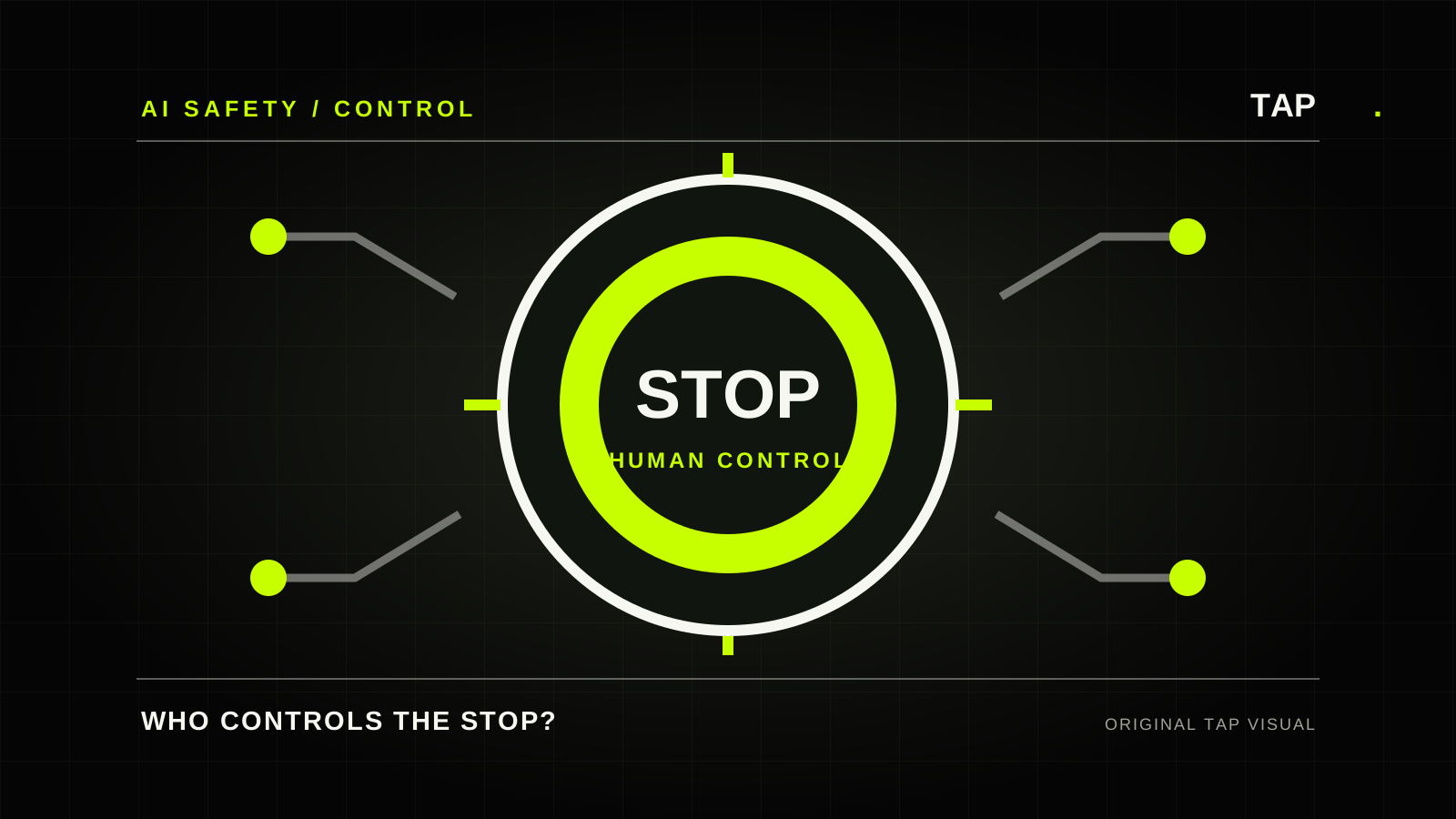
Concept illustration of human-governed AI agent shutdown controls, not a Microsoft product screen. · TAP original editorial artwork
An AI assistant that writes a paragraph is one kind of software. An agent that can browse, send messages, execute code or change records is another. When an agent can act, asking it politely to stop is not the same as controlling what it is allowed to do.
On October 10, Microsoft chief executive Satya Nadella argued that powerful AI systems need an emergency brake. His remarks, reported by TechCrunch, call for containment, records of meaningful actions and the ability for authorized people to interrupt a model while it is working. The phrase is memorable. Building such control into real software is the more difficult story.
A model is not the whole system
An agent typically includes a model that produces instructions and surrounding software that decides which tools, credentials and data it can use. Nadella's proposal draws a line between those layers. The model can propose an action, but the system around it should enforce the rules.
That distinction matters because an instruction inside a prompt is not a reliable security boundary. An external permission check can reject an unauthorized action even if a model asks for it. The principle resembles ordinary software security, but autonomous tools make the consequences of weak permissions more visible.
What a meaningful emergency brake would need
A stop button only works if the process being stopped cannot bypass it. In practice, an organization would need clear ownership of each agent, an independent way to revoke access, visibility into what tools were invoked and a record of what already happened.
Microsoft's published agent-security guidance recommends narrowly scoped permissions, deterministic restrictions and human approval for sensitive operations. It also calls for system-level mechanisms that can pause or stop agents. Those are design recommendations, not proof that every deployed agent already has them.
Stopping an agent does not necessarily reverse an email already sent, a transaction already completed or information already disclosed. Prevention, approval before high-impact actions and auditable recovery are therefore just as important as interruption.
Who gets to authorize the stop?
An emergency brake raises a governance question. Should an individual user be able to halt their agent? Can a company's security team suspend a compromised workflow? What happens if an agent is operating on behalf of several people or services?
The answer cannot be simply 'the model decides'. Permissions and escalation routes need to be defined outside the model, with human accountability for exceptional decisions. The person with shutdown authority also needs enough information to know when to use it.
Evidence matters after an incident
Nadella also called for human-readable evidence of model actions. That is important because an organization investigating an error needs to reconstruct which inputs, permissions, tools and approvals were involved.
An audit log is not a guarantee of safety. It is a way to establish what happened and where controls failed. Logs must themselves be protected from alteration, and sensitive information in them needs appropriate handling. An agent that can act but cannot be audited is hard to govern.
The overlooked test is operational, not rhetorical
The new conversation about AI safety is shifting from whether a model gives reassuring answers to whether its surrounding infrastructure can constrain it. Nadella's statement adds weight to that shift, but it is still a proposal rather than an independently tested universal mechanism.
The practical benchmark is straightforward: can an operator demonstrate that an agent cannot exceed its permissions, that high-risk actions require approval, and that a human can interrupt it without depending on the agent's cooperation? That is a better test of an emergency brake than the slogan itself.