· 7 min read
Europe's Deadliest Summer Heat Was a City Emergency We Barely Saw
A study estimates more than 50,000 heat-related deaths across hundreds of European cities. The numbers are modeled, but the public-health consequences are real.
By TAP Desk
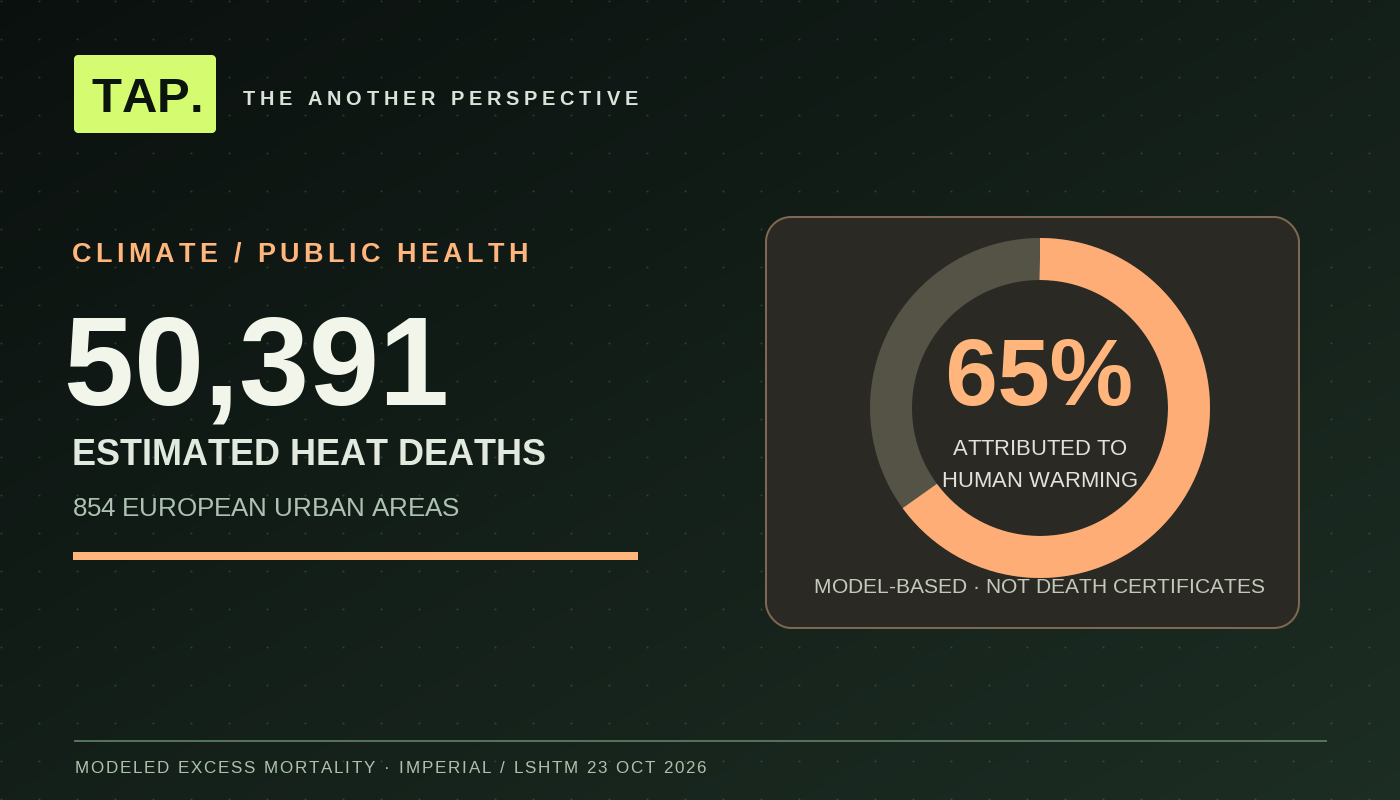
Modeled study results for June–August 2026. Estimates are not verified individual death records; see Imperial/LSHTM October 23 report. · TAP original editorial artwork
Some disasters look like sudden events. Summer heat often does not. Its effects move through apartments that never cool, workers exposed to the sun, older residents living alone and health systems trying to absorb a rise in emergencies. By the time the season ends, many of the losses have not become a single dramatic headline.
An October 23 study led by researchers at Imperial College London and the London School of Hygiene & Tropical Medicine estimates 50,391 heat-related excess deaths across 854 European urban areas during summer 2026. About two-thirds are attributed to human-driven climate change. That is an estimate generated by statistical models, not a tally of medical certificates listing heat as a cause. Understanding the distinction is essential to understanding what the findings can—and cannot—tell us.
A big number with a specific boundary
The study examined 854 cities across 27 European Union countries, the United Kingdom, Norway and Switzerland. Those urban areas represent approximately 40% of the population of the 30 countries covered. It therefore does not claim to count the total heat-related mortality of every country in Europe, much less all deaths during the year.
The researchers estimate 50,391 excess deaths related to summer heat. Associated Press reports that roughly 32,619, or about 65%, were attributable to anthropogenic climate change in the analysis. These figures are best read as model estimates with uncertainty, not exact counts of identifiable deaths or an official continental death registry.
Such analysis compares observed temperature patterns and established heat-mortality relationships with modeled conditions in a world without the added warming from human activity. It offers a way to estimate the change in population risk, even when a death certificate records a heart condition or respiratory illness rather than heat exposure itself.
Why the city is the key unit
Urban centers concentrate buildings, roads and pavement that store heat. Many homes lack effective night-time cooling, and outdoor workers cannot simply pause essential services when the temperature rises. Age, pre-existing illness, income, housing quality and access to healthcare can turn the same weather forecast into very different risks.
The study's focus on urban areas matters for policy. City authorities can provide public warnings, cooling rooms, shaded public spaces, drinking water and checks on residents living alone. Employers can adapt schedules and rest conditions. Hospitals can plan staffing and outreach for periods when emergency demand spikes.
These measures do not eliminate climate warming. They reduce the chance that a specific heatwave becomes fatal for people who have limited ability to escape it. At the same time, only reducing the heat added by greenhouse gases can change the longer-term baseline on which future extremes build.
The weeks when mortality accelerated
LSHTM reports that nearly one-third of the estimated summer deaths occurred during the intense heat from June 17 to July 1. The research group's release described daily temperatures across the region that were more than five degrees Celsius above the 1991–2020 average during this period. One extreme stretch can therefore account for a large share of seasonal mortality.
Southern and western Europe saw the largest temperatures and estimated mortality rates, according to the researchers. But northern cities were not spared. In the British urban areas included, researchers estimated about 4,500 heat-related deaths. The study also estimated roughly 6,000 deaths among residents younger than 65 across the study area.
That last figure is a reminder not to reduce heat protection to a story only about retirement homes. Older adults bear particular risk, but exposure at work, chronic illness and inadequate housing can threaten people far younger. A warning that focuses on one demographic may fail to reach others who need it.
Why the climate-attributable share matters
The analysis distinguishes all heat-associated deaths from the portion linked to additional warming caused by human activity. Without that distinction, readers might incorrectly infer that every heatwave death can be directly attributed to climate change, or that no death would have occurred in the absence of fossil-fuel emissions. Neither conclusion follows from the methodology.
Researchers applied established epidemiological tools and counterfactual temperatures to estimate how much the added heat changed expected mortality. The counterfactual is not an alternative history that can be observed. It is a scientifically constructed comparison and must be evaluated together with uncertainty around the data and methods.
The study's message remains serious despite these limits. A modeled difference of tens of thousands of deaths is a signal that health systems and city planning should take heat exposure as a predictable, rising population risk rather than an inconvenience requiring only an occasional advisory.
What a serious response would measure
The first measure is whether emergency warnings reach people before dangerous conditions arrive. The second is whether they have somewhere safe to go. The third is whether health services can respond, including through neighborhood visits to isolated residents and protection for workers required to be outside.
Countries should evaluate how many residences can stay below dangerous indoor temperatures, how much access to cooling is available to low-income residents and whether hospitals see fewer heat-related emergencies after interventions. These metrics are more useful than counting tree-planting announcements or issuing alerts that people lack the means to follow.
Reducing fossil-fuel emissions operates on a different timeline but remains necessary. Short-term adaptation buys protection for people alive today. Long-term emissions cuts aim to prevent the temperature baseline from continuing to rise and make every adaptation effort progressively more expensive.
The TAP perspective: an invisible disaster is still a test of governance
When heat claims lives across hundreds of cities, no single scene tells the complete story. Population models make its scale visible, but they should not become an excuse to treat individuals as statistical abstractions. For every aggregate risk there are decisions about housing, working hours, medical services and whose warning gets heard.
The comparison to make next summer is not only whether the temperature reaches another record. It is whether the cities studied in 2026 have installed protections, measured access to cooling and reached those who are hardest to contact. If those protections improve, the public-health toll can change even in a warming climate.
That is the larger conclusion from the October report. The number is alarming, and its modeling limitations should be stated. But the real question is what governments do with knowledge of a recurring, measurable danger.