· 6 min read
The $63 Billion AI Chip Deal Is Really a Bet on Who Holds the Risk
Banks and Blackstone are financing AI hardware for Anthropic through a special-purpose vehicle. The most important part is who owns the chips if the economics change.
By TAP Desk
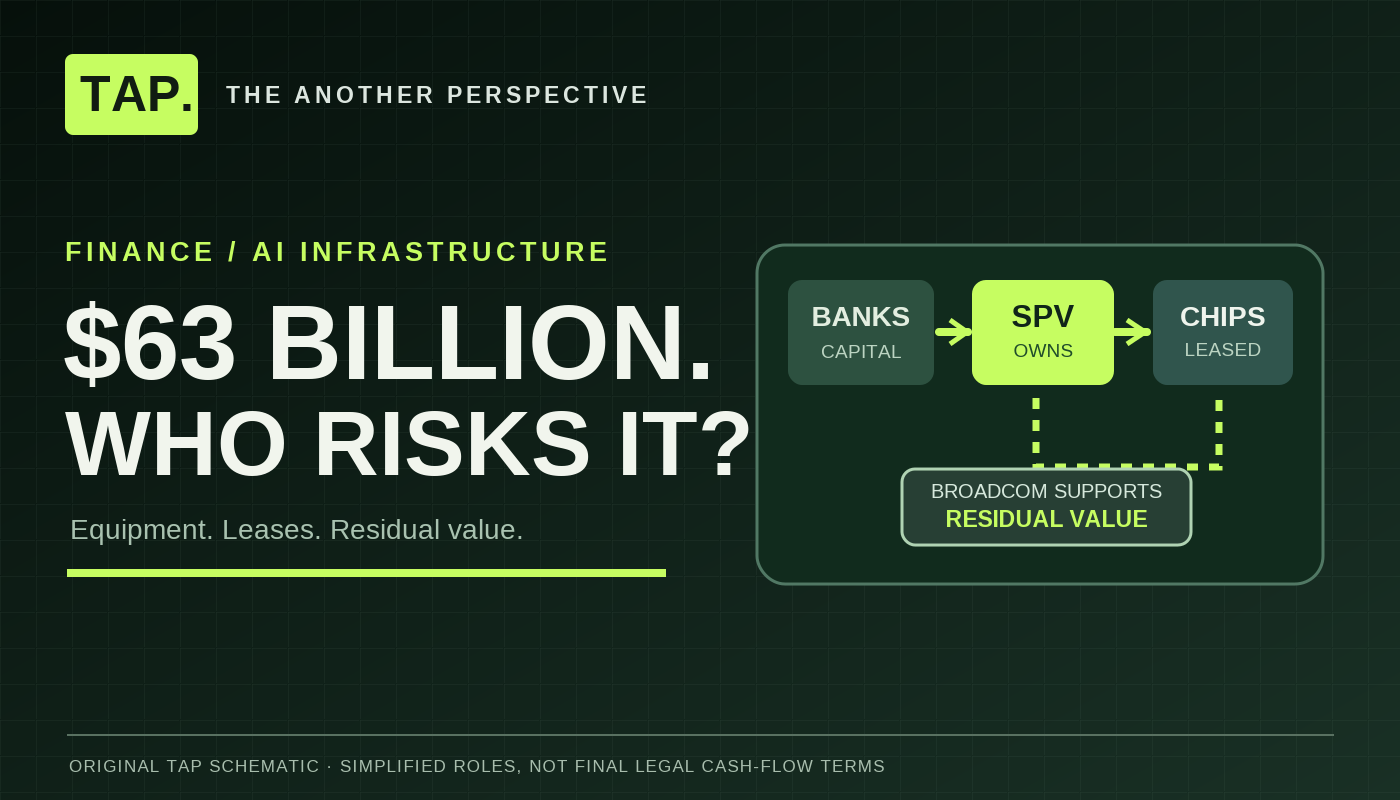
Conceptual transaction diagram, not a complete legal financing waterfall. Source: Broadcom's October 26 announcement. · TAP original editorial artwork
Sixty-three billion dollars is a number that can make a technology announcement sound like an achievement already completed. On October 26, Broadcom and four financial partners announced financing on that scale to support AI computing equipment for Anthropic, the maker of Claude. But the machinery has not all arrived, the money has not all necessarily been drawn and Anthropic is not simply taking out a conventional $63 billion corporate loan.
The agreement instead lays out a financial structure in which a separate vehicle buys specialized processors and networking gear, then leases the equipment to Anthropic. The details raise a more interesting question than the headline figure: if demand changes or today's expensive hardware loses value quickly, who is carrying the downside?
A buyer, a borrower and a user are not the same entity
The announcement describes a newly created special-purpose vehicle, or SPV. Its job is to acquire Broadcom AI accelerators and networking products using financing arranged by banks and a major alternative-asset manager. Anthropic is the intended customer leasing the equipment. This separates the company that uses computing capacity from the vehicle that owns and finances some of the underlying hardware.
That distinction matters because the announcement should not be retold as if Anthropic itself has already borrowed the entire headline amount. A leasing agreement creates obligations and risks, but they are organized differently from an ordinary unsecured loan. The public statement does not provide every final lease payment, interest rate or equipment delivery schedule. It describes a committed framework for future purchases and leases.
Four famous names occupy different places in the stack
Bank of America, Citi and Morgan Stanley are arranging the first-lien financing, debt with a senior claim on relevant collateral and cash flows under the deal structure. Blackstone is described as the sole provider of the committed second-lien financing, which sits behind the first lien. The announcement does not give readers a complete set of final financing terms or a full waterfall for every scenario.
Reuters reports a first-lien amount of approximately $43.5 billion. That figure belongs to Reuters' account, not to a disclosed breakdown in the partners' joint statement. Distinguishing the two is essential when a headline financing total is being mistaken for cash handed to the technology company. The size of each lending layer changes which participants are most exposed to different kinds of losses.
The unusual part is Broadcom's protection for lenders
Broadcom says it will provide residual value support to the SPV equal to the first-lien portion of the financing. In plain language, residual value is about what an asset is worth after it has been used for years. That question is unusually significant when the asset is specialized AI hardware rather than a building or a conventional machine with a long-established resale market.
Computer equipment may remain productive for many years, but its economic value can also move rapidly as more efficient chips and new architectures arrive. Support against that value uncertainty can make senior financing more attractive. It does not mean there is no risk left. The exact contractual triggers, future hardware market, lease payments and ability of all participants to perform remain important. Broadcom's support also connects the chip supplier's own financial exposure to how well the financed equipment retains value.
Why AI infrastructure is starting to resemble project finance
Most people encounter AI as a chat window or a productivity feature. Running advanced models at large scale, however, requires a long chain of physical investment: chips, network equipment, data centers, electricity and maintenance. A company can want more computing capacity without wanting every piece of hardware on its own balance sheet. Lenders and leasing vehicles can connect long-term equipment spending with the customers expected to use it.
That is what makes this deal significant beyond Anthropic. It points toward a market where financial institutions and technology suppliers help determine who gets access to expensive computational infrastructure. The capacity is valuable only if future customers, workloads and revenue justify its cost. The structure reallocates that uncertainty rather than making it disappear.
The calendar is as important as the number
The companies expect equipment deliveries to begin in calendar 2027 under a previously announced strategic computing-capacity arrangement. Expected deliveries are not the same thing as installed systems operating today. Their timeline can change as production, networking, site readiness and customer requirements evolve. Broadcom's own release emphasizes the uncertainties associated with supply, demand and implementation.
The same day, Anthropic announced that it had filed an S-1 registration statement for a proposed US stock-market listing. That does not mean an IPO has closed or that offering proceeds can be counted on to pay for this equipment. The share count and price range were undetermined at the time of the announcement. Investors should separate a proposed listing, a financing commitment and the actual deployment of chips.
The TAP perspective: follow the obligations, not only the dollars
The question worth following is not whether the AI sector can produce another record-sized financing headline. It is whether lenders, equipment makers and model companies have found a sustainable way to share the cost of hardware that may need frequent replacement. This structure gives Anthropic access to a financing model, banks a senior lending opportunity, Blackstone a junior layer and Broadcom a way to support equipment demand while assuming some residual-value exposure.
None of that establishes a crisis or an inevitable payoff. It establishes a web of promises that will be tested over years by actual installations, leasing income, changing chip economics and the resilience of the parties making those promises. Before calling the deal either an AI triumph or a debt bubble, look at what gets delivered, what gets paid and who is responsible if the equipment is worth less than everyone expected.