· 7 min read
Anthropic Reported an $80.7 Billion Loss. Most of It Wasn't Cash Leaving the Business.
Anthropic's IPO filing has two enormous figures: revenue of $16.3 billion and a net loss of $80.7 billion in the first half of 2026. The accounting underneath changes the story.
By TAP Desk
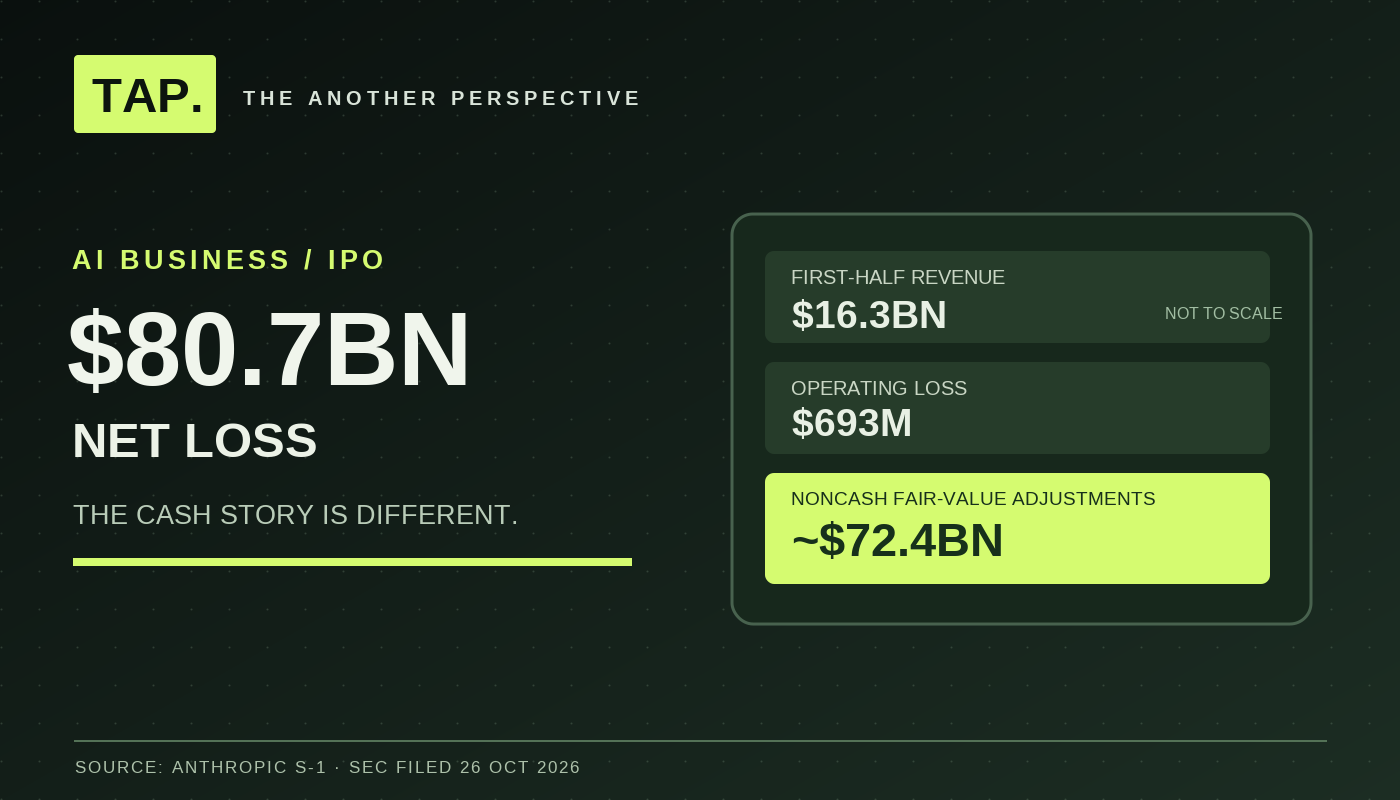
Separate measures from Anthropic's October 26 SEC Form S-1; values deliberately not visualized as comparable-scale bars. · TAP original editorial artwork
Anthropic's newly public IPO paperwork contains a combination of numbers capable of distorting almost any headline: $16.3 billion in revenue for the first half of 2026 and $80.7 billion in net losses over the same six months. Readers might conclude that the company spent tens of billions more cash than it made while racing to develop Claude. That is not what the filing shows.
Anthropic filed its Form S-1 with the U.S. Securities and Exchange Commission on October 26 as it proposed listing Class A shares on Nasdaq under ANT. The prospectus describes rapid sales growth and substantial economic risks. But the distinction between reported net loss, operating loss and cash spending is essential before judging what the business model can support.
Three different numbers describe three different realities
Revenue measures the value of products and services delivered to customers during the period under the company's accounting rules. Anthropic reported about $16.3 billion in revenue in the first six months of 2026, up from about $1.2 billion a year earlier. That is dramatic growth, but it is not profit and does not directly tell readers how much cash was collected in the bank.
Operating loss is closer to the economics of running the business: revenue minus operating costs recognized in the period. The filing shows an operating loss of roughly $693 million, compared with approximately $2.1 billion in the first half of 2025. Those numbers suggest a change in the relationship between recognized revenue and operating expenses, not proof that every product or computing contract is profitable.
The striking $80.7 billion net loss is affected by accounting well below operating income. Roughly $72.4 billion came from changes in the estimated fair value of convertible notes, derivative liabilities and agreements that can convert into equity. Those changes can become large when the valuation of a private company rises. They should not be casually relabeled as a bill for servers, staff or electricity paid during those six months.
Why the noncash charge matters
Some companies raise funding through instruments that convert to shares or whose value changes with the value of the business. Under accounting rules, revaluing those instruments can produce a loss on the income statement even when no corresponding cash payment occurs at that moment. This is precisely why a headline based only on net income can mislead readers about cash burn.
That does not mean a noncash charge is fictional or can be ignored. It may reflect future claims on equity, dilution or financial obligations that matter to shareholders. But its economic interpretation differs from the immediate cost of buying computing capacity or serving a customer. The proper analysis asks how liabilities are structured, what payments may occur and how much ownership existing investors retain.
Investors also need the cash-flow statement and notes to the financial statements rather than treating one accounting line as the complete cost of developing AI. The S-1 provides far more information than a single profit-and-loss total, and those details will matter as the proposed public offering advances.
The operating business has its own expensive question
Even with rapid revenue growth, training and serving frontier AI models requires substantial processing power, electricity, specialist engineers and access to infrastructure partners. A profitable-looking revenue chart does not reveal whether contractual infrastructure spending will remain proportionate as demand, model efficiency and competition change.
The company's disclosures discuss those development and infrastructure risks. Some compute agreements may extend across years, while the revenue they are meant to support depends on future customers and pricing. That mismatch creates an execution challenge even for a company with accelerating sales. Better model efficiency could lower unit costs; competitive pressure could also reduce what customers will pay.
This is why the most useful comparison is not simply between Anthropic and another AI company's valuation. It is between the cost of producing useful AI work and the price enterprises will consistently pay for that work. As the market matures, retention, gross margin, operating expenses and recurring customer demand will be central.
An S-1 is an invitation to examine, not a completed IPO
On October 26, Anthropic announced its formal registration statement and an intention to trade under the symbol ANT. It did not announce a final offering price or number of shares. The company states the registration statement has not yet become effective and the proposed shares cannot be sold before that happens.
Market talk of a record valuation or an imminent trading debut therefore remains separate from what the company has formally proposed. A valuation will depend on the terms of a future offering and what buyers are willing to pay, not on speculation repeated in press coverage. The number printed on a financial story can create the illusion that a company has already achieved a transaction that remains ahead.
The IPO process also invites closer scrutiny of governance, competition and disclosures than private-company announcements typically receive. Anthropic's public benefit corporation identity and unusual governance arrangements are important topics in their own right, but neither status automatically resolves tensions among growth, safety and shareholder interests.
What a more honest IPO scorecard looks like
The first column should contain revenues and their composition: how much customers buy, through which channels, and whether purchases recur. The second should measure operating economics: the spending required to build and serve AI products, alongside the price customers are willing to pay. The third should capture financing and accounting: how convertible instruments, future obligations and share issuance may affect investors.
Each column can move in a different direction. Strong revenue growth can coexist with operating losses; improving operating performance can coexist with an extraordinary noncash accounting adjustment. A growing public market can assign a large value to a business before it has demonstrated stable long-term margins.
None of this makes the IPO inherently sound or unsound. It makes the information in the prospectus more useful than the loudest number pulled out of it. A business whose products may affect many industries deserves a serious analysis of the business itself.
The TAP perspective: follow the cash and the contracts
Anthropic's reported first-half net loss makes for an arresting headline, but the accounting behind it is not the same as a claim that the company burned $80.7 billion in cash. The filing discloses strong revenue growth, a smaller operating loss and a large noncash valuation adjustment. All three can be true simultaneously.
The most consequential questions concern sustained demand for its AI products and the financial commitments required to supply them. Future public-company reporting can make those trends easier to compare, but the price of admission is resisting numbers without context.
For now, Anthropic has filed to pursue a public listing. It has not completed the offering. Investors, customers and readers should separate the proposed deal from the operating company and separate the company's operating company from its accounting treatments.