· 6 min read
Brazil's Market Crashed After the Vote. The Ballot Wasn't the Whole Story.
Brazil's election result triggered a historic market selloff. The gap between what investors expected and what voters chose is the more revealing story.
By TAP Desk
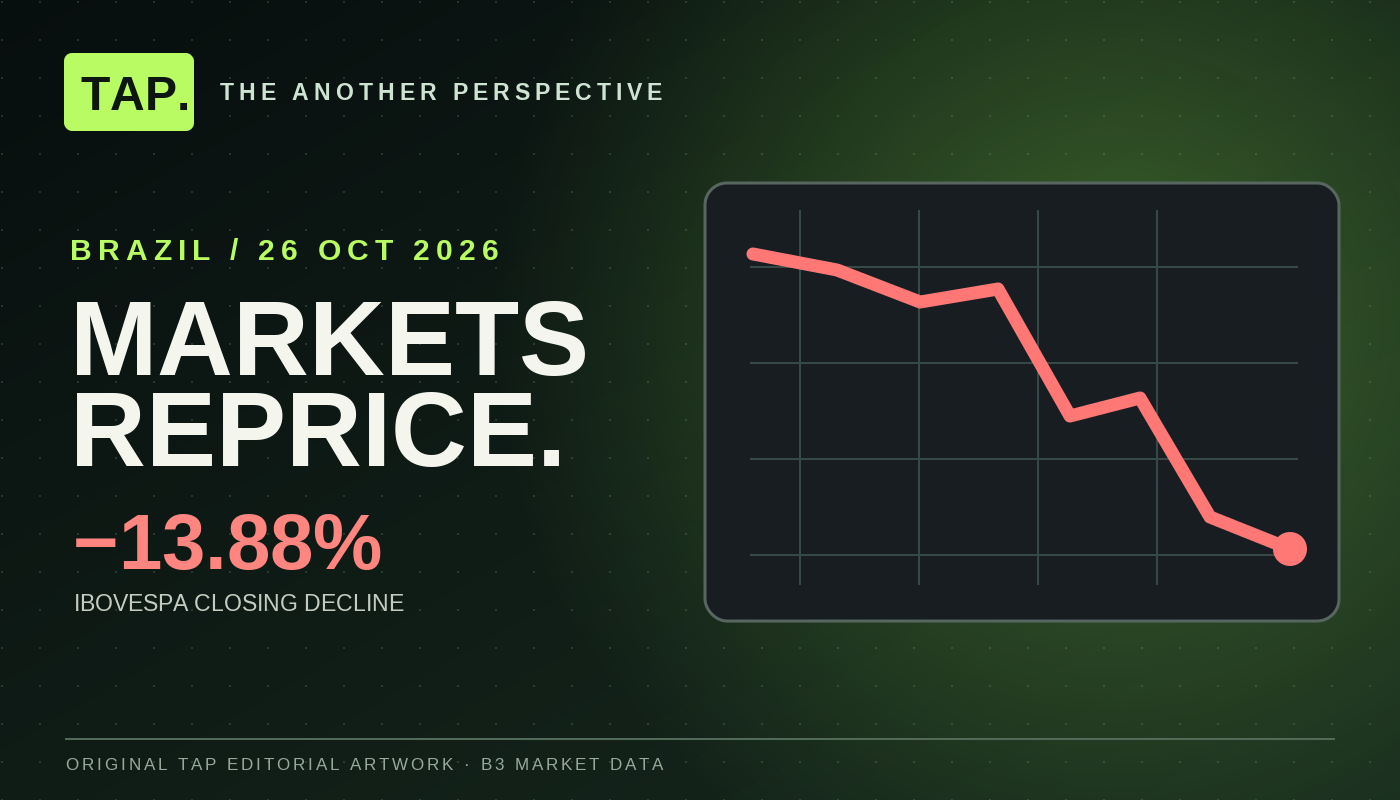
The 13.88% Ibovespa closing decline is sourced to B3 on October 26, 2026. Chart line is conceptual. · TAP original editorial artwork
Brazil's presidential runoff produced a result at the ballot box on Sunday and a very different kind of verdict on trading screens the next morning. On October 26, the benchmark Ibovespa fell sharply enough for exchange operator B3 to suspend trading for half an hour. By the close, it had lost 13.88%, according to B3's own market report. The scale of the move invited an easy headline: investors rejected the election result. That description misses an important part of the story.
The market was not starting from a neutral position. Many investors had positioned for a victory by Senator Flávio Bolsonaro, after he led the first round. Instead, the electoral court confirmed that President Luiz Inácio Lula da Silva had won another term. A surprise can trigger a sudden repricing even when the democratic process has delivered a legitimate outcome. The question is what the selloff reveals about expectations, public finances and the people exposed to the fallout.
First, separate the vote from the trade
Brazil's Superior Electoral Court said Lula won 64,256,232 votes, or 51.79% of valid ballots, against Bolsonaro's 59,826,041, or 48.21%. Those are election results, not market forecasts. They establish who won the vote. They do not establish whether investors will like the next government's economic programme. Nor does a falling stock index supply evidence that an election was invalid. These are different questions, governed by different institutions and standards of proof.
Reuters reported that Brazilian assets had rallied after the first round as investors increasingly anticipated a rightward political shift. Bolsonaro's first-round lead encouraged expectations of tighter fiscal policy and lower borrowing costs. By the Friday before the runoff, the benchmark stock index was almost 7% above its level before the first round. A position built on a particular political outcome becomes vulnerable when that outcome fails to materialise. The resulting selloff can reflect forced adjustments and reassessment, not a single collective opinion about every policy Lula might pursue.
What the circuit breaker actually means
B3's October 26 notice says the exchange suspended a range of cash-market securities, private fixed income, equity-linked options and exchange-traded funds for 30 minutes. The mechanism was triggered after the Ibovespa fell 10% from its previous close. Trading was scheduled to resume through an auction between 10:30 and 10:35 local time. A circuit breaker is a temporary operational pause during an exceptional move. It is not a cancellation of trades already made, a guarantee that prices will rebound or a judgement about the country's election.
The market continued to fall after trading resumed. B3's end-of-day report put the index at 176,608.23, down 13.88%, with an intraday low of 169,516.43. Folha independently reported the same closing percentage and a peak intraday decline of 17.34%. These figures should not be mixed: the 17.34% number describes the deepest point during the session, not the final loss. Early Reuters dispatches also carried preliminary closing figures before the final exchange tally. TAP uses B3's published end-of-day figure as the reference.
The selloff reached beyond shares
The real weakened, government bonds came under pressure and the cost of insuring against sovereign default rose. Reuters reported that Brazil's five-year credit-default-swap spread moved from 120 basis points at Friday's close to 144 on Monday. The Treasury cancelled scheduled auctions of certain government bonds. Those details matter because a market shock can move beyond the wealth of equity investors. Higher financing costs, if sustained, can affect the state, companies seeking loans and households paying for credit.
Folha reported that the dollar closed at R$5.409, an 8.41% daily increase, while B3's market report put the commercial dollar at roughly R$5.40 and an 8.25% rise. The sources use different market quotes or conventions. The defensible shared finding is a steep depreciation of the real. A weaker currency can support some exporters' local-currency revenues, but it can also raise the cost of imported inputs. B3's own closing table showed some exporters rising even as the broad index collapsed. A market is never one uniform constituency.
Fiscal anxiety is real. So is the danger of treating it as destiny
Investors have substantive questions about Brazil's debt path and future budget choices. Reuters quoted analysts focused on the next finance minister, the credibility of any fiscal adjustment and the challenge of maintaining social programmes while restraining borrowing costs. Those are legitimate issues for any administration. They are not answered by a one-day stock chart. A market price incorporates changing expectations, liquidity needs, risk tolerance and the positioning of participants who may have been wrong about the vote.
There is also a political temptation to tell the story as a contest between responsible markets and irresponsible voters, or between democratic voters and malicious financiers. Neither shortcut is adequate. Voters choose among competing visions for public spending, wages, services, taxes and institutions. Investors price expected cash flows and financial risks. These decisions overlap, but they are not substitutes for each other. A government should be accountable for its economic programme; investors should not be mistaken for an alternative electorate.
The overlooked question is who absorbs the adjustment
A 13.88% index decline does not mean the Brazilian economy contracted by 13.88% in a day. Stock prices are valuations of listed companies, not a direct measure of national output, wages or household welfare. But the consequences of a sustained shock can eventually spread. More expensive debt can squeeze public budgets. A weaker currency can raise import costs. Tighter financing can delay investment and hiring. Those channels are possibilities, not outcomes that can already be attributed to the October 26 session.
The next evidence will be more useful than the first reaction. Watch whether the government names a finance team and publishes a credible, testable fiscal path. Watch what happens to bond yields, currency pricing and actual financing conditions over weeks rather than minutes. Watch how social commitments and fiscal constraints are reconciled in concrete budget decisions. And watch whether the initial selloff reverses as uncertainty declines. An extraordinary trading day is evidence of stress, but it is not a full economic forecast.
The TAP perspective
Brazil's market did not vote, and the election did not set share prices. The collision came because many investors had already made a bet about what voters would do. When that bet failed, markets had to adjust rapidly. The difference matters: it keeps an electoral mandate separate from the financial system's expectations without pretending that the economic consequences of those expectations are imaginary.
The more consequential test begins after the circuit breaker. Can Brazil protect democratic legitimacy, communicate an economically credible programme and prevent a sudden repricing from becoming a prolonged squeeze on credit and living standards? That question is harder than the dramatic image of a falling screen, and it is the one worth following.