· 6 min read
China's AI Export Plan Has Two Clocks. One Is Already Running.
Beijing is consulting on restrictions covering 40 technologies, including 23 AI categories. But a separate pre-export registration requirement begins immediately. The distinction matters for companies moving know-how abroad.
By TAP Desk
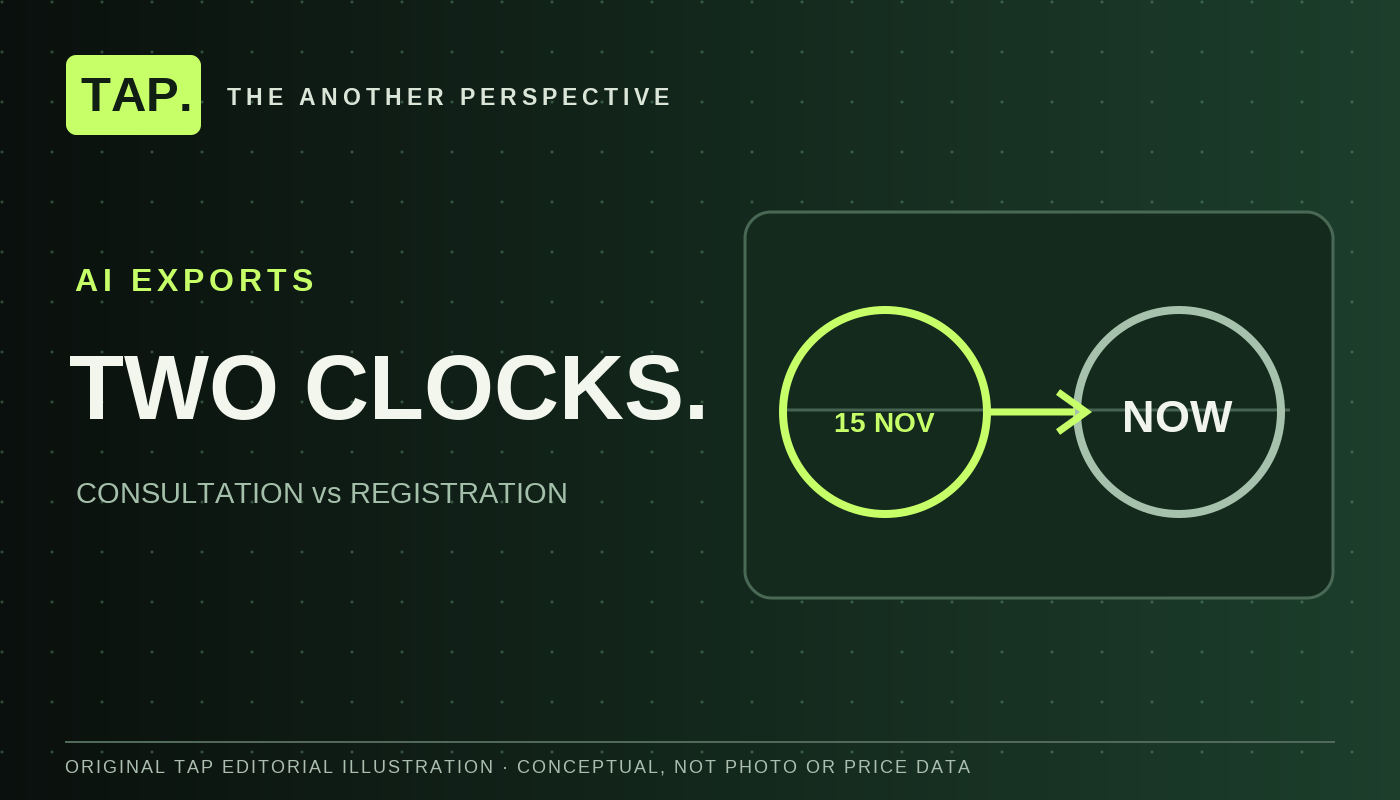
Conceptual artwork. China's October 16 proposal remains open for comments until November 15; registration began immediately. · TAP original editorial artwork
The headline sounds like a sweeping new ban: China wants to restrict exports of important artificial-intelligence technology. But reading the October 16 government announcement reveals two different regulatory events, with different timelines and different consequences.
China's commerce and science ministries have proposed adding 40 technologies to a catalogue of prohibited or restricted exports. Twenty-three are related to AI, including large models, agents, computing clusters and information processing. That list is open for comment until November 15. Separately, companies handling transfers of the technologies identified in the notice face a pre-export registration requirement beginning now. Treating those two measures as if they were the same finished ban would mislead readers.
One policy proposal, one immediate obligation
Announcement No. 48 invites feedback on a revised technology-export catalogue. The ministry's accompanying explanation says 14 of the 40 proposed entries would be prohibited and 26 restricted. Those totals cover AI, biomedicine and photovoltaic technologies together, not AI alone. The final wording may change after consultation.
The same announcement also creates an interim registration system. Operators transferring covered technology overseas must register before export while the revised catalogue is being finalized. The government says that requirement also applies to relevant exports that have started but have not yet been completed. Registration is a real present-day administrative step; it should not be described as proof that every covered transfer has already been prohibited.
This distinction matters for international business planning. A company may need to identify and report a proposed technology transfer immediately while still waiting to learn the precise final restrictions. That is a compliance burden even before any final catalogue decision.
Technology transfer is not the same as opening an AI app
The government's examples of registrable activity focus on moving technology ownership or use rights abroad: selling intellectual property, licensing domestic technology for foreign use, or changing a technology owner's effective control to a foreign entity. These are not interchangeable with an ordinary person using an AI chatbot on a website.
In its explanatory Q&A, the commerce ministry draws a specific distinction between covered restricted technology deployed overseas and services delivered through an API, app, web interface or software-as-a-service product. It says those routine remote access methods do not count as model technology exports under the proposed framework. Overseas local deployment can count, with some simplified licensing routes described for lower-risk arrangements.
These are the ministry's explanations of its intended policy, not an independent legal determination for every product or contract. Exporters would still need to assess the precise technical scope, their transaction structure and the final published rules.
Open source is a consequential exception
The official notice excludes technologies already placed in the public domain through open-source distribution or published academic research. That qualification is more than a footnote. It means the proposal is not accurately summarized as 'China is banning open-source AI exports.'
The ministry also describes facilitation for some collaborative research and cross-border computing arrangements. How these exceptions operate in practice will depend on implementation, but their existence changes the basic reading of the measure. A public model, a proprietary set of model weights and a private technology-transfer contract may face different questions.
At the same time, the open-source carve-out does not automatically make every associated private method, manufacturing process or contractual transfer exempt. A public model can coexist with nonpublic know-how. The line between a published artifact and the proprietary capability used to produce or deploy it deserves close scrutiny.
The geopolitical headline leaves out a business problem
Reuters placed the proposal against rising technology competition between China and the United States. That context is relevant. But the ministry says the review is part of routine technology-trade administration and is not aimed at a particular country. Both the geopolitical setting and the government's stated rationale should be reported without pretending they settle its ultimate motivation.
For a company, the near-term question is practical: which technology is moving, who controls it, what rights change hands and what documentation is required? A multinational research partnership, an AI product sold through a web service and an overseas transfer of proprietary technical assets are not the same transaction.
The TAP perspective is that technology controls increasingly govern the movement of expertise, intellectual property and infrastructure, not just boxes of chips at a border. The immediate story is the registration obligation. The longer story is whether the final rules draw predictable boundaries that allow legitimate research and trade while restricting capabilities the government considers sensitive.
What to watch before calling this a crackdown
November 15 is the announced deadline for public comments. The next evidence points are the final catalogue, any changes to technical thresholds, implementation guidance and documented licensing decisions. None of those outcomes is established merely by today's announcement.
A more accurate headline is less dramatic but more useful: China has proposed a narrower set of technology-export restrictions while starting interim registration for covered transfers. That is a significant policy move. It is not a completed universal ban on exporting Chinese AI.