· 7 min read
The Next US–China Technology Restriction Targets Money, Not a Shipment
The US Treasury wants to extend outbound-investment screening to biotechnology and other sensitive sectors. China objects. The proposal is not yet the final rule.
By TAP Desk
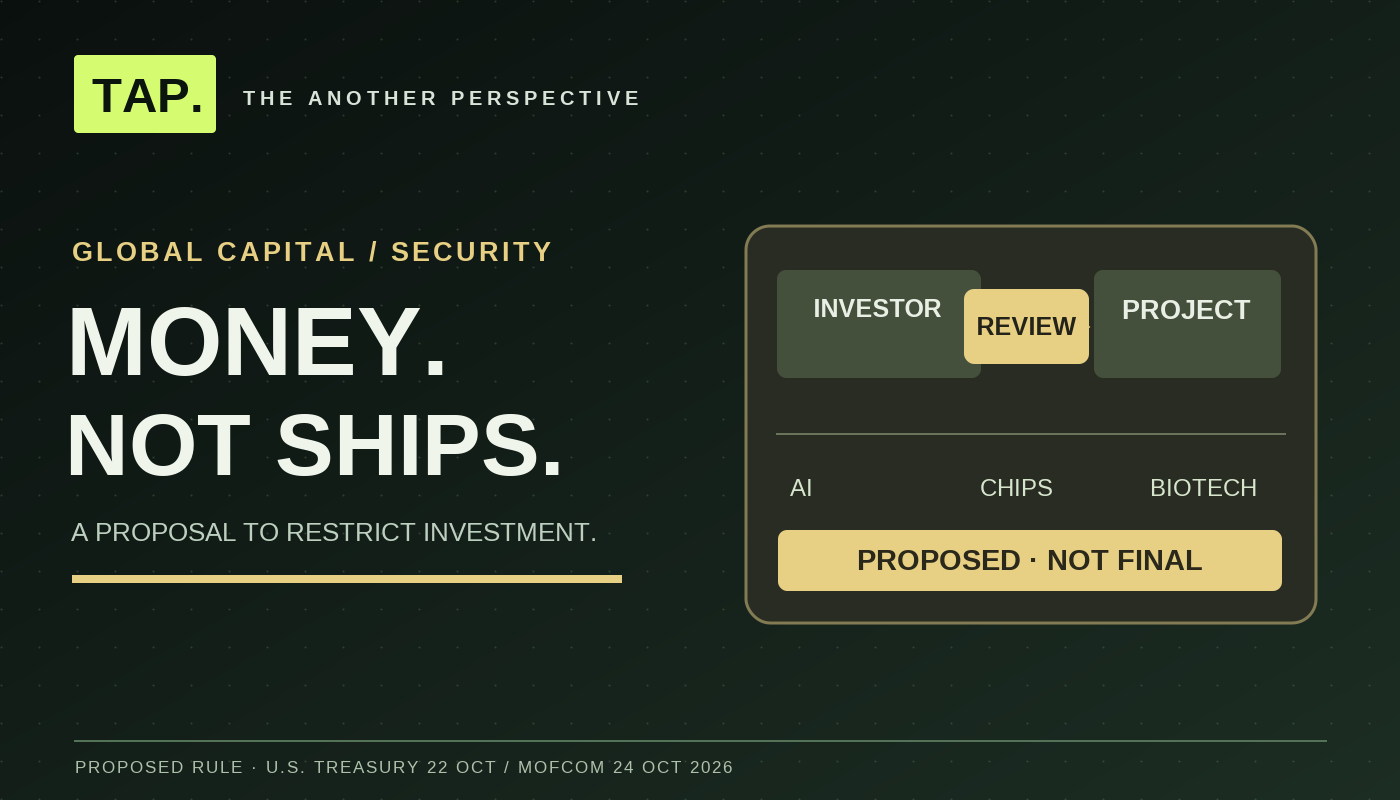
Conceptual diagram of proposed rules, not a physical export restriction or an operative ban; Treasury October 22 and MOFCOM October 24. · TAP original editorial artwork
Technology restrictions are often described as border controls: a government stops a shipment of chips, software or laboratory equipment. The latest United States–China dispute works at another point in the supply chain. Washington is proposing broader restrictions on the money US investors can put into certain foreign technologies. On October 24, China's commerce ministry publicly objected.
The US Treasury published a proposed rule on October 22 to implement the Comprehensive Outbound Investment National Security Act. It would extend and refine controls spanning sensitive semiconductors, AI, quantum systems and additional fields including biotechnology. It remains a proposal open for comment, not a finalized blanket ban. That distinction matters to investors, entrepreneurs and researchers whose financing may be affected long before any physical product crosses a border.
The restriction is about investment relationships
A conventional export control restricts the transfer of specified goods or technology. Outbound-investment rules instead examine transactions in which a US person provides capital to a covered foreign business developing sensitive capabilities. A company might have access to inputs and customers but still face obstacles accepting US money if the transaction falls within a prohibited category.
Treasury's October 22 proposal describes both transactions that must be notified to the government and others that would be prohibited, subject to definitions, technical criteria and exceptions. That is materially narrower than a ban on all US investment abroad. The legal test would involve the type of entity, the technology, the investor and the nature of the transaction.
These details can matter as much as the headlines. A financing round may include several investors, corporate partnerships and follow-on obligations. A rule that touches a particular investment does not automatically mean every research agreement, purchase order or sale involving the same company is forbidden.
Why biotechnology is the new pressure point
The existing US program, implemented under a 2023 executive order, has addressed certain investments associated with advanced semiconductors, quantum information and AI. Treasury now proposes implementing legislation passed in 2025 and identifying biotechnology as an added category of potentially sensitive capability. The proposal also addresses high-performance computing and hypersonic systems.
Biotechnology is not a single product. It includes research tools and applications with enormously different purposes, from medicines and diagnostics to technologies that officials worry could have security implications. Any rule using a broad sector label must eventually define which specific activities are covered. Companies and investors need those definitions to distinguish legitimate scientific collaboration from transactions that regulators consider security risks.
Axios reported concerns that the biotechnology language could reach a wide range of pharmaceutical products, while also noting uncertainty around the treatment of licensing arrangements. A careful analysis should resist concluding that all biotech licensing deals have become illegal. What a proposal might cover is not identical to what a final regulatory text will prohibit.
Washington and Beijing tell different stories
Treasury frames the program as a national-security measure meant to prevent US capital from helping foreign adversaries develop dual-use technologies with potential military, surveillance, intelligence or cyber applications. That is the US government's stated rationale, not proof that every company in the affected sectors has such uses.
China's Commerce Ministry responded on October 24 that the proposal widened discriminatory investment restrictions and politicized commercial relationships. In its original Chinese-language statement, the ministry said it opposed the move and reserved the right to take corresponding measures. Reuters separately reported the dispute that day.
Neither statement resolves the underlying policy disagreement. Washington argues some financing can accelerate strategic capabilities it seeks to contain. Beijing argues expanded controls can disrupt otherwise legitimate investment and scientific activity. The assertion that retaliation is possible should not be reported as if a new set of countermeasures had already been enacted.
What is in force now—and what is not
US outbound-investment regulations took effect in January 2025 for certain technologies and persons associated with countries of concern. The October 2026 notice builds on that program and invites public submissions until December 7, according to Treasury's official program page. The newer proposed changes are not yet final regulations with all effective dates settled.
That timeline creates two different compliance questions. One concerns obligations already in place; the other concerns potential changes that investors might prepare for as comments are evaluated. Treating a proposed requirement as immediately operative can discourage lawful investment and confuse businesses. Treating the proposal as politically irrelevant because it is not final can also be careless.
For investors, the practical work includes mapping covered entities, identifying the technologies involved, understanding transaction structure and following official guidance. For researchers and smaller companies, the uncertainty itself can matter if funders postpone decisions while awaiting clearer rules.
The effect may arrive before any restriction takes effect
Investment markets respond to anticipated risk. If a potential lead investor worries that a future deal could trigger notification, review or prohibition, fundraising might slow before the rules are finalized. Other investors may fill the gap, or projects may reorganize ownership and financing. These are possible consequences, not outcomes proven by the October announcement.
That uncertainty can weigh especially heavily on early-stage research companies, whose spending often precedes commercial revenue by years. Biotech teams may require several rounds of investment to support trials and development. A change in potential sources of capital can matter even when all parties continue trading physical goods normally.
At the same time, investment screening may be designed to address credible security concerns that simple export controls cannot capture. The task for policymakers is to define those concerns narrowly enough to protect national interests without collapsing ordinary science and commerce into a single security category.
The TAP perspective: capital is becoming part of the technology border
Technology competition does not stop at the customs checkpoint. It also determines who can fund a laboratory, finance a computing cluster or take an ownership stake in a promising company. That is why the real story behind the Treasury proposal is not a new shipment ban. It is a proposed change to the investment pathways through which technologies grow.
The most revealing next documents will be the public comments, the final definitions of covered activities, the treatment of exceptions and Treasury's eventual effective dates. Those will show whether the rules function as targeted security safeguards or create a much wider drag on cross-border innovation.
For now, the facts are narrower than the rhetoric. Washington has issued a proposal, Beijing has objected and reserved a response, and the consultation remains open. The law's next stage—not the loudest warning—will establish what businesses actually have to do.