· 5 min read
China Grew 4.5%. Who Feels the Recovery?
The GDP headline hides a sharp contrast between strong factories and weak consumer demand.
By TAP Desk
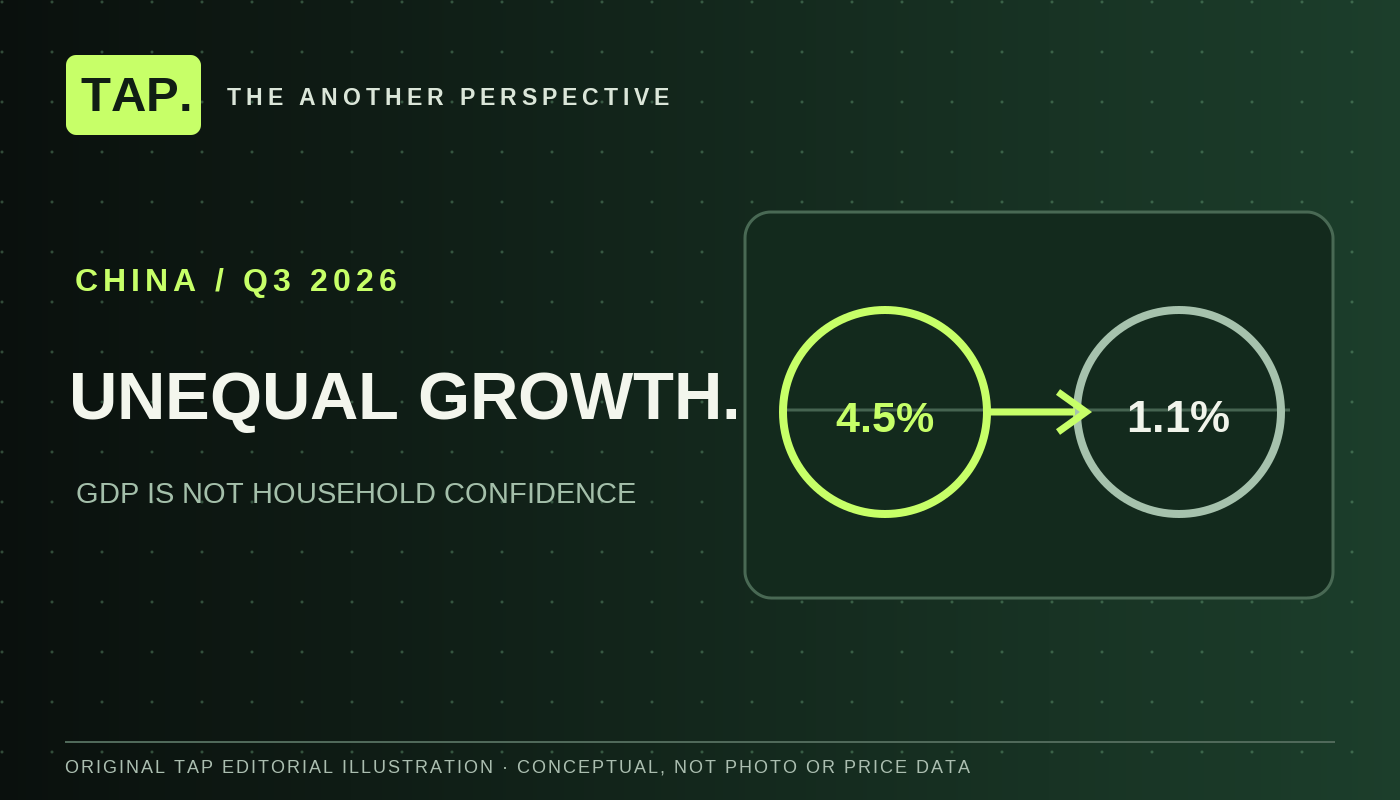
Conceptual comparison. GDP and retail consumption growth cover different reporting periods; not an equivalent financial comparison. · TAP original editorial artwork
China's economy grew faster than expected in the third quarter of 2026. The National Bureau of Statistics reported on October 19 that output increased 4.5% from a year earlier, up from 4.3% in the previous quarter. The figure beat a Reuters poll forecast of 4.4% and moved China closer to its official annual growth target. It was a strong headline for an economy navigating trade friction and a prolonged property downturn.
But GDP is not a household mood survey. The same release describes factories that are growing faster than consumers are spending, and an investment picture still weighed down by housing. China can be getting better at supplying the world without every family feeling more secure about spending at home.
The factory is moving faster than the shopper
Industrial production increased 5.5% year on year in September. Across January through September, high-tech manufacturing value added rose 14.3%. Those figures show a real source of strength: China's advanced industrial capacity, including goods demanded by overseas markets. Export orders can keep plants busy even when local shoppers are cautious.
September retail sales, by contrast, rose only 1.1% from a year earlier. That was an improvement from August's 0.4%, but it remained modest next to industrial growth. These are different measures, so their percentages are not a direct comparison of welfare. Their divergence nevertheless reveals a crucial economic question: how does factory momentum become stronger household demand?
China's GDP rose 4.6% across the first nine months. That measures total production, not whether wages, household wealth, private investment and consumer confidence are improving together. A broad recovery requires more evidence than a better-than-expected quarterly number.
The property market changes the calculation
Fixed-asset investment declined 7.2% year on year over January through September. Within that total, property-development investment fell 20.6%. Both figures describe the first nine months, not September alone. They point to a persistent weakness in a sector that influences household balance sheets, construction employment and business confidence.
Property is a major store of wealth for many households. When home values or income prospects feel uncertain, families may be less willing to make discretionary purchases. That is a plausible economic mechanism, not proof that every household has reduced spending. The October data cannot measure all the personal decisions behind the national totals.
Reuters reported economists' view that growth had stabilised without becoming fully self-sustaining. Export demand can ease pressure on policymakers to introduce broad stimulus. It cannot, by itself, resolve a property slump or guarantee that households will become confident spenders.
Export strength comes with a trade-off
Associated Press reporting on October 20 described strong exports and a roughly $938 billion trade surplus over the first nine months of 2026. Demand for technology-intensive manufactured goods has helped support growth. AI-related infrastructure investment is one reported driver, but the sources reviewed here do not quantify its precise contribution to the 4.5% GDP figure. An 'AI caused China's growth' headline would claim more than the data show.
Competitive Chinese goods can benefit buyers abroad, but large trade surpluses also create political friction. Importing economies may respond with tariffs or restrictions to protect local producers. That leaves exporters exposed to decisions made outside China, even if their factories remain efficient.
The deeper challenge is balance. An economy that relies heavily on customers elsewhere can look resilient while domestic demand remains fragile. Stronger household spending and private investment would make the expansion less dependent on the next global export cycle.
The TAP perspective
A broader recovery would eventually show up across several measures: sustained retail growth, a less severe property decline, healthier private investment and household incomes supporting repeat spending. One quarter of GDP data cannot establish all of that, and a weak consumer number should not erase genuine manufacturing advances.
China's October 19 figures tell a mixed but coherent story. Output has accelerated modestly and high-tech manufacturing is expanding. Domestic demand and property investment remain weak. Growth asks how much an economy produced. Recovery asks how widely that momentum reached people. Those are not yet the same question.