· 6 min read
Your Money Was Safe. Why Couldn't You Use It?
Revolut customers lost access to ordinary banking functions during Google's London cloud outage. The October 27 engineering report identifies the power failure, but financial-access resilience is still the larger question.
By TAP Desk
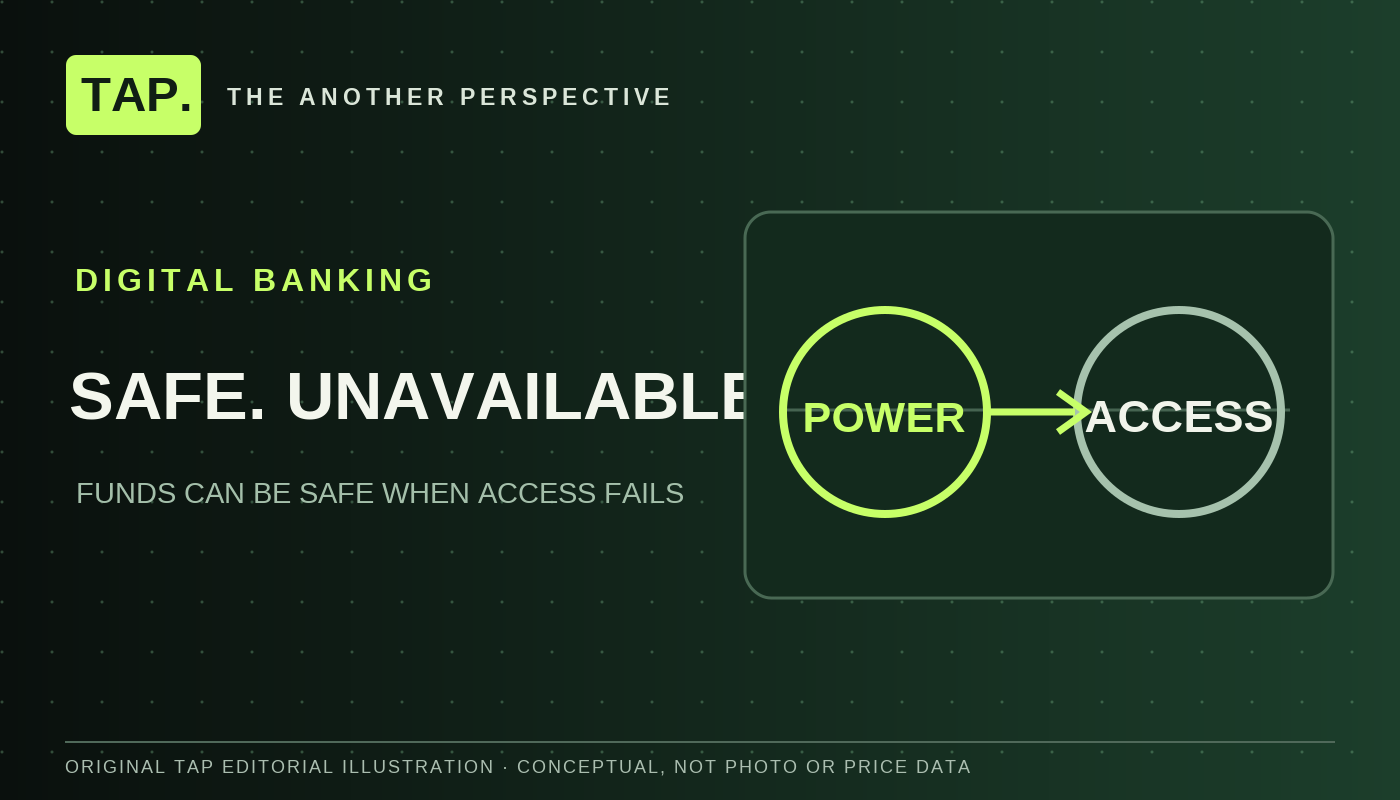
General illustration of cloud infrastructure and payment availability, not actual Revolut or Google Cloud interface. · TAP original editorial artwork
At a checkout counter, a banking outage is not an abstract cloud-computing problem. It is the moment a payment fails while a customer has money in an account they cannot use. On October 20, that distinction became visible as Revolut reported widespread service problems while Google Cloud acknowledged disruption in its London region.
Google's October 27 incident report now explains a six-hour power failure at the europe-west2-b data center zone. A utility feeder fault and misconfigured backup-generator controllers prevented automatic restoration when UPS reserves ran down; the disruptions also spread to some healthy zones through capacity surges and control-plane dependencies. During the incident, Revolut customers experienced problems with sign-ins, card payments, transfers and withdrawals. Reuters reported the connection to Google Cloud, and Revolut later publicly acknowledged a recent Google Cloud outage. Both companies have since reported restoration of services.
Two failures, one customer experience
The two companies' dashboards tell different stories because they measure different things. Google's page describes infrastructure: elevated errors and network failures in a named region. Revolut's page describes the actions a customer or merchant cannot reliably complete. A cloud region can sound remote until its failure reaches the payment terminal or an ATM.
Revolut said customers' funds and data remained safe. That reassurance matters, and the reporting reviewed does not establish that money disappeared or accounts were compromised. But safety and availability are separate promises. An account balance can remain intact while a customer temporarily loses the practical ability to pay, transfer or withdraw.
The Guardian documented customer-facing disruption on October 20, while The Next Web reported Google's status information and the overlap in timing. Their reporting supports the visible disruption. It does not, by itself, disclose Revolut's complete internal architecture, how much of its workload was hosted in the affected region, or why particular functions failed.
Why a cloud partnership matters, but does not answer everything
Revolut and Google Cloud announced an expanded strategic partnership in September 2025. Revolut described Google's infrastructure as a foundation for scaling its systems and improving services. That makes the provider relationship relevant to the story, but it is not proof that Revolut lacked redundancy or that a single technical mistake caused every failed transaction.
Modern financial apps depend on layers of infrastructure: identity, databases, payment processing, networking, security checks and external financial networks. A disruption in one layer can make a service unusable even if others remain healthy. This is a general explanation of distributed systems, not a finding about Revolut's unpublished architecture.
Google's incident notice advised affected customers to consider moving workloads to another available zone or region if feasible. The phrase 'if feasible' is doing important work. Moving a stateless web page is not the same as moving a banking system that must preserve accurate balances, transaction ordering, fraud controls and audit trails. Redundancy has to be designed, tested and paid for before a crisis.
The hidden question is not whether cloud services can fail
Every infrastructure provider can experience failures. The more consequential question is how a company defines acceptable disruption and how clearly it explains the limits of its backup plans. Customers rarely see whether a bank has independent regional capacity, alternate payment paths, manual support procedures or rehearsed recovery steps.
None of those measures can be assumed absent here. An outage is evidence that some user journeys failed; it is not a complete audit of a company's resilience program. The right questions for a post-incident report are specific: which dependencies failed, which services were isolated, what protections worked, what did not, and what will change.
The episode also shows a tension in digital finance. Apps promise a frictionless relationship with money, often without the visible branch network or paper processes that once provided alternatives. That convenience can be real. So can the cost when the interface becomes the only practical route to funds.
What customers and regulators should ask next
Customers deserve a timeline, a clear account of affected functions, guidance on disputed or duplicate payments, and a way to document consequential losses. These are questions for providers, not a claim that any particular compensation or legal remedy has already been established. Businesses dependent on digital payments need their own continuity plans as well.
Regulators and enterprise customers should focus less on the comforting phrase 'multi-cloud' and more on demonstrated recovery. A second provider is useful only if essential systems can actually switch over without corrupting records or creating new security problems. Even multi-region deployment may leave shared identity or control-plane dependencies.
Google's final incident report, published October 27, identifies an external underground utility cable fault and a backup-generator control configuration problem. The report says two programmable controllers sensed voltage upstream of a disconnected feeder and therefore failed to start generators; UPS batteries eventually depleted. Google also describes capacity pressure and control-plane dependencies that disrupted some services outside the physically affected zone. This is a technical explanation of the Google Cloud incident, not a complete public account of Revolut's internal failover design.
What the October 27 engineering report changes
Google's investigation narrows the cause of the cloud disruption from an unexplained incident to a specific electrical and control-system failure. The backup architecture was designed with duplicate utility feeds and generators, but the facility was temporarily operating with one primary feeder during repairs. When that feeder failed, the controller did not detect that both downstream paths had lost power. The generators did not receive the start command. The report estimates the primary customer-impact window at about six hours and eight minutes.
Critically, Google reports some impact outside the affected physical zone as failover traffic strained neighboring capacity and control-plane requests timed out. That demonstrates why multi-zone design is not an automatic guarantee of seamless service; the details of capacity, cross-zone dependencies and recovery mechanisms matter. This observation does not establish that Revolut had no contingency plan.
European financial regulators are seeking explanations from Google about the outage. The public question has shifted from what failed to what systems and institutions will change after the failure. Source: Google's October 27 incident report and Reuters October 21 regulatory reporting.
The TAP perspective
The headline is that a cloud outage hit banking services. The deeper story is that the security of money and access to money are different dimensions of trust. When a bank tells customers their funds are safe, it should also be able to explain how customers can use those funds when the technology underneath the app fails.
The standard worth demanding is not 'never goes down.' It is transparent failure, credible recovery and practical alternatives when everyday financial life depends on a handful of invisible systems.