· 6 min read
A Space Telescope Is Falling to Earth. Its Most Valuable Work May Outlive It.
Swift has stopped watching cosmic explosions and is expected to re-enter soon. The bigger story is the rapid-response network it built and the scientific archive it leaves behind.
By TAP Desk
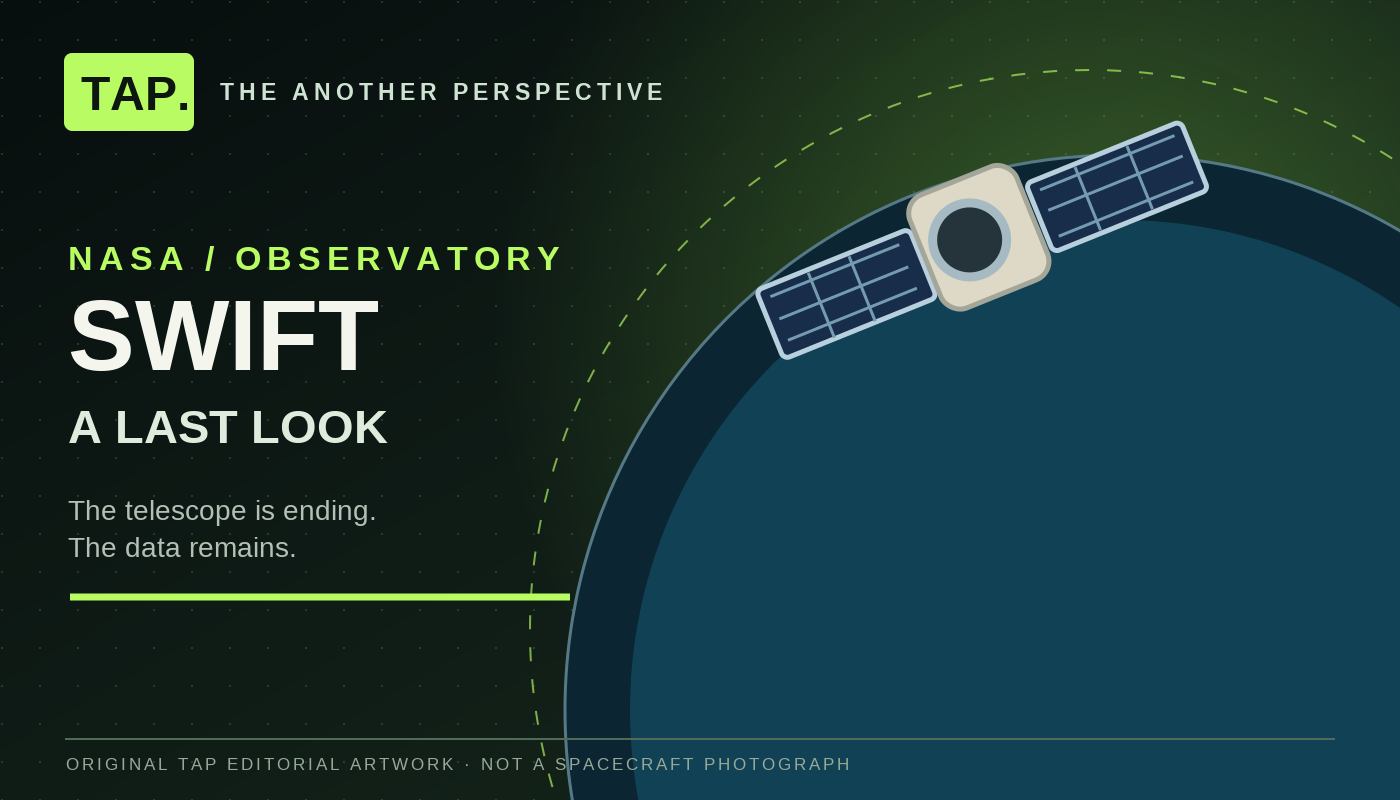
Swift ended science operations in October 2026. Artist's interpretation, not a spacecraft photograph. · TAP original editorial artwork
The Neil Gehrels Swift Observatory has spent nearly twenty-two years looking for things that do not wait. A burst of gamma rays might flash across the sky and fade before a conventional telescope has time to turn. Swift was built to notice the flash, tell other astronomers where to look and move its own instruments into position while there was still something to see. On October 23, NASA announced that this work had ended.
The spacecraft made its final scientific observation on October 20. By then its orbit had fallen to about 275 kilometres above Earth, where increasing atmospheric drag made stable observing impossible. NASA expects it to re-enter the atmosphere in the coming weeks. The obvious headline is that a veteran telescope is falling out of space. The more useful question is what disappears when an observatory that responds to the unexpected goes quiet.
It was not just a telescope. It was an alarm system.
Many observatories are designed to stare deeply at carefully selected patches of sky. Swift had a different assignment: catch the sudden event first, locate it and help a global community react. Its Burst Alert Telescope watched for high-energy outbursts; its X-ray and ultraviolet/optical telescopes then refined the picture. NASA says the sequence of detection, notification and repositioning could typically take about a minute. That speed made a difference when the most informative afterglow was fading.
One early result shows why. In 2005, Swift captured an X-ray afterglow from a short gamma-ray burst lasting just 0.03 seconds. Short bursts had been difficult to pinpoint quickly enough for detailed follow-up. The observation helped strengthen a theory linking some of these flashes to collisions involving neutron stars. A machine capable of acting promptly changed which scientific questions were practical to ask.
Twenty-two years of observations is not the same as twenty-two years of data value
Launched in November 2004 for a planned two-year primary mission, Swift outlasted its original design horizon more than tenfold. NASA credits it with observing over 2,000 gamma-ray bursts and more than 1,400 supernova explosions, alongside activity around black holes, comets and other targets. Its observations have contributed to roughly 7,000 scientific papers. Those are mission-reported totals, not independent measures of the quality of every study.
The spacecraft's archive is also unusually tangible: NASA describes about 12 terabytes of publicly available observations, including more than 1.5 million images from the ultraviolet/optical telescope. A student who never saw Swift operating can still examine old observations, compare events or revisit an interpretation with new methods. The archive cannot capture tomorrow's explosion. It can, however, keep generating questions and answers long after the satellite is gone.
The failed rescue was a test of a different future
Swift's decline was not a sudden hardware breakdown of its science instruments. Increased solar activity expanded Earth's upper atmosphere, raising drag on the low-orbit spacecraft. Mission managers changed how Swift pointed and paused observations to buy time for a commercial servicing attempt. NASA contracted Katalyst Space Technologies to send a robot called LINK to approach and lift the observatory into a higher orbit.
That boost did not happen. Independent reporting by the Associated Press described control problems aboard LINK after launch; later reporting in The Guardian documented its September 25 re-entry after the rescue was abandoned. LINK and Swift are different spacecraft, with different fates. The failed attempt does not prove orbital servicing is impossible. It does show how difficult it is to reach, control and modify a satellite that was never designed to be grabbed by a robot.
There is a trade-off hidden inside the final months
In early 2026, the Swift team temporarily reduced scientific operations to orient the spacecraft in ways that slowed its orbital decay. When the rescue was scaled back, NASA restarted observations in late August and restored additional capabilities in September. That brought fresh data, but pointing at targets again also increased drag. By October 20, Swift had reached the altitude at which the team could no longer maintain stable observing and entered safe mode.
This is a real engineering choice, not a simple story of a machine being neglected. Conserving altitude could protect a possible future for the telescope while sacrificing observations today. Returning to science could capture events that would otherwise be missed while bringing the end closer. The mission's final decisions illustrate why operating an ageing spacecraft means allocating scarce time, not merely waiting for it to fail.
What a missing first responder changes
Other telescopes still observe gamma rays and transient events, and NASA says it is exploring ways to use and augment existing missions and possible new capabilities. But a constellation of instruments is not automatically a drop-in replacement for a spacecraft designed to detect an event, locate it and follow up across wavelengths within minutes. Each part of that chain has its own sensitivity, viewing constraints and operational priorities.
The next scientific loss is therefore not necessarily a single dramatic discovery that can be named in advance. It is the set of brief events for which a rapid, coordinated observation would have been possible with Swift and may now be harder to arrange. Measuring that gap will require looking at what other observatories actually detect and how quickly they respond, rather than assuming the sky has gone unwatched.
The TAP perspective: the satellite ends, the scientific infrastructure remains
Space missions are often judged by their launches, budgets and spectacular photographs. Swift suggests another metric: how much useful capacity a mission creates for everyone else. Its alerts made other telescopes more valuable by telling them when and where to look. Its public archive allows people who were never part of the original team to test new ideas using old measurements. Both are forms of scientific infrastructure, though only one can continue operating after shutdown.
There is no need to romanticise the ending. A failed rescue means a working observatory's active contribution has stopped, and NASA has not reported a completed Swift re-entry as of its October 23 announcement. But the mission's more lasting achievement may be that it turned fleeting cosmic flashes into shareable, searchable evidence. The next challenge is to preserve that rapid-response culture even without the spacecraft that helped build it.