· 7 min read
A planet may have been born from the ashes of its own dead star.
Astronomers say a planet candidate around white dwarf HS 0209+0832 appears to have formed from material expelled when its star died. If confirmed, it would be the first known example of a planet forming around a white dwarf.
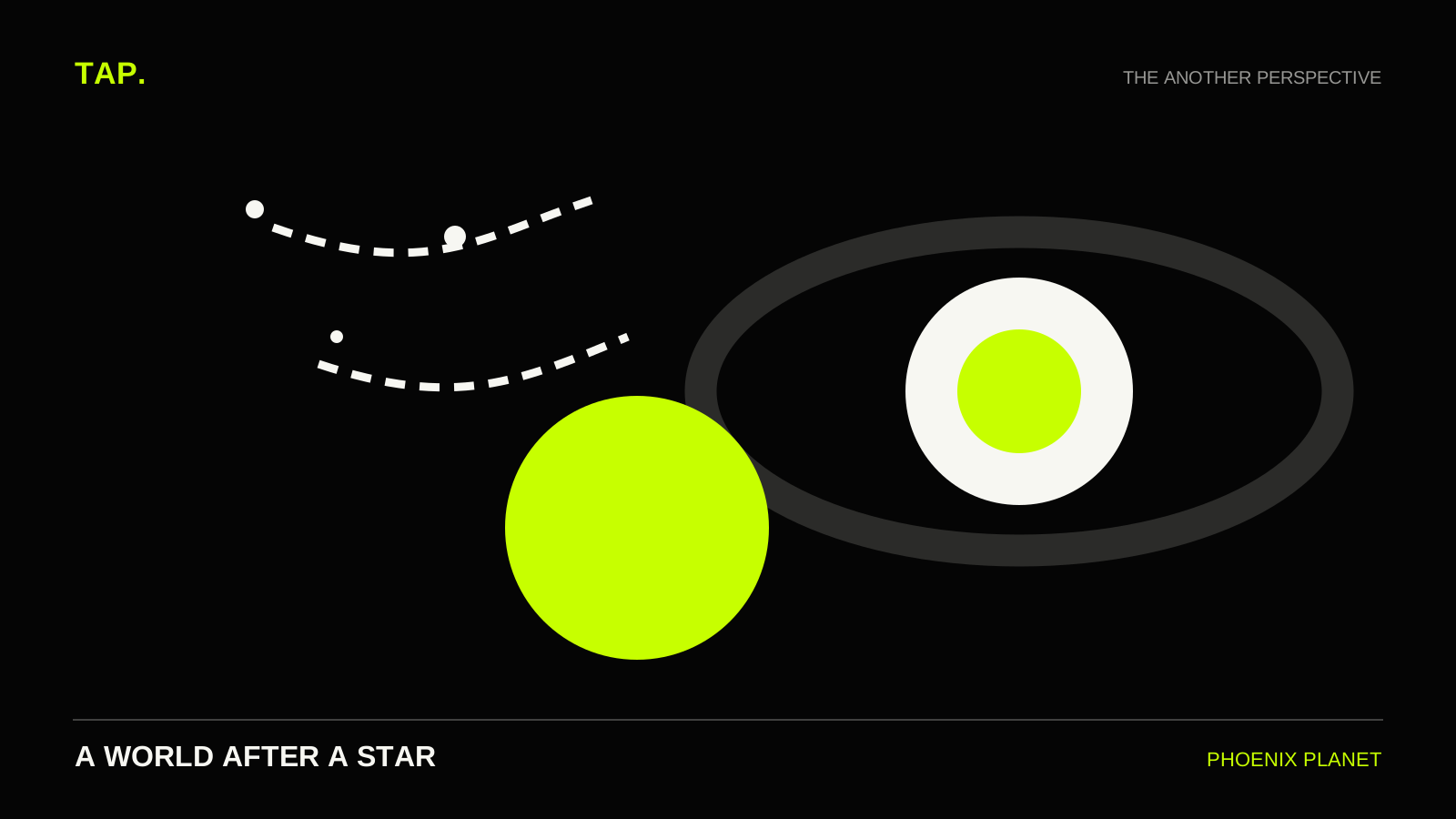
Fig. — A second-generation planet around a stellar remnant.
Planets are supposed to be born young.
A star forms. Material left in a disk around it clumps together. Worlds emerge while the system is still in its early life.
Astronomers have now reported a candidate that appears to have followed the opposite sequence: its star died first, and the planet formed later from the debris.
Meet HS 0209+0832
The system is about 250 light-years away in the constellation Cetus. Its central object is a white dwarf, the dense remnant left after a Sun-like star sheds its outer layers.
Researchers reported evidence for a gas-giant planet orbiting the white dwarf every 4.4 days.
The planet sits extraordinarily close to the hot stellar remnant, and radiation is expected to strip material from its atmosphere.
Why the chemistry is the clue
White-dwarf atmospheres can act like forensic evidence.
The researchers found unusual heavy elements associated with material falling onto the star. The chemical pattern did not look like a normal old planet simply being destroyed.
Instead, the team argues that the planet appears to have assembled from material expelled during the star's late evolution.
The University of Warwick describes it as a second-generation planet candidate: a world built from the remains of a previous planetary era.
Why this is surprising
The death of a star is normally destructive for nearby planets.
As a Sun-like star expands into a red giant, inner worlds can be engulfed while outer orbits are disrupted. The star later sheds much of its mass and collapses into a white dwarf.
The new result suggests that the debris left behind may not remain debris forever. Under the right conditions, some of it may settle into a disk and build a new planet.
Is the planet definitely confirmed?
The researchers call it a planet candidate, and follow-up observations are important.
Reuters reported that the team plans to use the James Webb Space Telescope to study the system further.
That caution matters. Extraordinary systems can have competing explanations, and a second-generation planet is a much stronger claim than simply detecting material around a white dwarf.
Why astronomers care beyond one strange world
If this interpretation is confirmed, it changes the possible timeline of planet formation.
Planetary systems would not be limited to one construction phase at the beginning of a star's life. Under some conditions, stellar death could create the raw material for another round.
That also changes where astronomers might search. Chemical signatures around other white dwarfs could reveal additional second-generation worlds.
What this says about our own future
Our Sun is expected to become a white dwarf billions of years from now.
That does not mean a new Earth will form afterward. But the discovery raises a more interesting possibility: a planetary system's story may continue after the star that created the first generation is gone.
Some cosmic endings may contain the material for another beginning.