· 8 min read
Trillions of particles pass through you. Almost none notice you are there.
Neutrinos are tiny, electrically neutral particles that interact so weakly with matter that they can pass through planets. That strange property makes them difficult to detect and unusually valuable for understanding the Sun, stars and extreme cosmic events.
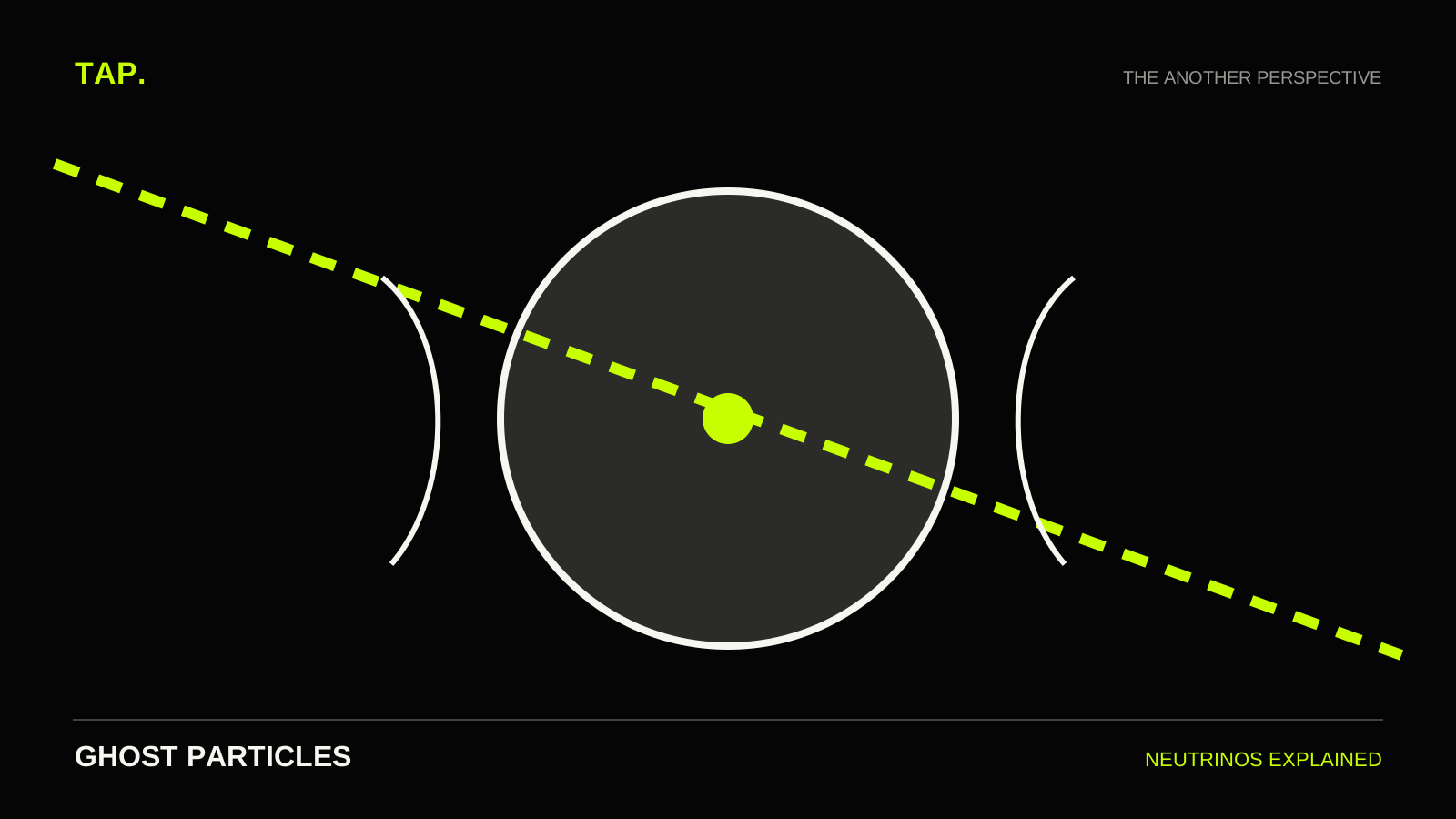
Fig. — Mostly invisible, occasionally detectable.
Neutrinos are among the most abundant known particles in the universe, yet everyday life gives almost no hint that they exist.
They stream out of the Sun, nuclear reactions and violent cosmic events. They cross the atmosphere, pass through your body and continue through Earth.
Most of them do not collide with anything.
What is a neutrino?
A neutrino is an elementary particle in the lepton family. It carries no electric charge. We now know neutrinos have a tiny amount of mass, although far less than familiar particles such as electrons.
CERN describes neutrinos as particles that interact so rarely with matter that they can travel through extraordinary amounts of material without stopping.
Why are they called ghost particles?
The nickname comes from their weak interaction with ordinary matter.
Matter feels solid because the particles inside atoms interact through electromagnetic and other forces. Neutrinos do not carry electric charge, so they are unaffected by electromagnetism in the ordinary way.
They mainly participate in the weak nuclear interaction and gravity. That means most neutrinos pass straight through atoms without colliding with their nuclei or electrons.
If they hardly interact, how can we detect them?
Scientists compensate with size.
A small detector gives a neutrino very few chances to interact. A gigantic detector gives it more targets and more opportunities.
Some experiments use enormous volumes of water, heavy water, liquid scintillator or natural ice. When the rare interaction happens, the resulting charged particles can produce light or other signals that sensitive instruments record.
Why not just use light to study the universe?
Light does not escape every environment cleanly.
Dense matter can absorb photons. Dust can obscure objects. Extremely energetic regions can be difficult to study if their light is transformed before it reaches us.
Neutrinos can escape dense environments and travel enormous distances with very little disturbance. That makes them messengers from places that may be difficult to observe directly.
Where do neutrinos come from?
The Sun produces neutrinos through nuclear fusion. Earth's atmosphere produces them when cosmic rays strike air molecules. Nuclear reactors create large numbers of antineutrinos. Supernovae release enormous bursts.
IceCube focuses especially on very high-energy neutrinos from cosmic sources. Those particles can help researchers investigate the engines that accelerate matter to extreme energies.
Why neutrinos changed physics
For a long time neutrinos were assumed to be massless. Experiments later showed that neutrinos can change, or oscillate, between different types as they travel. That behavior requires them to have mass.
The result was important because the standard model of particle physics in its simplest form did not account for neutrino mass.
Why scientists still care
Neutrinos sit at the border between several huge questions.
They may help explain extreme cosmic accelerators. Their mass and behavior test fundamental physics. Large detectors can also register bursts from nearby supernovae before visible light reaches telescopes.
That is the strange appeal of the neutrino: the particle is valuable not despite being hard to detect, but partly because the same property lets it bring information from places other messengers cannot leave unchanged.