· 8 min read
A cubic kilometre of Antarctic ice helped win a Nobel Prize.
Francis Halzen won the 2026 Nobel Prize in Physics for turning Antarctic ice into a detector for high-energy neutrinos. The remarkable part is not only the particle. It is that a place most people see as empty became a new kind of telescope.
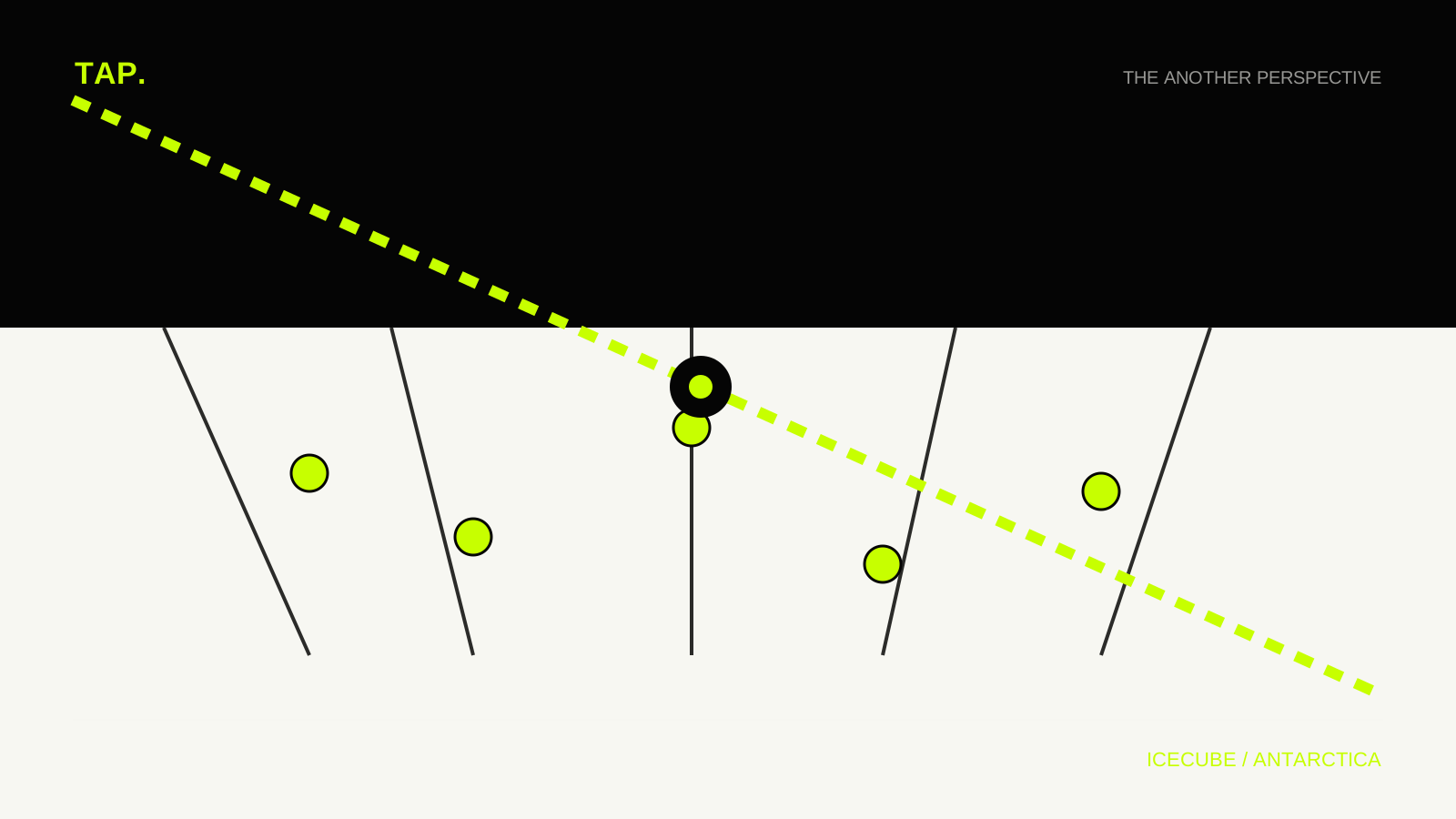
Fig. — A telescope made from ice.
The 2026 Nobel Prize in Physics went to a scientist who spent decades trying to see particles that are famous for barely interacting with anything.
Francis Halzen, a Belgian-American physicist at the University of Wisconsin–Madison, was recognized for pioneering the detection of high-energy neutrinos using the IceCube Neutrino Observatory at the South Pole.
The basic idea sounds backwards: if the particles are almost impossible to stop, build an enormous detector and wait.
1 km³
Approximate volume of Antarctic ice instrumented by IceCube
Why neutrinos are useful precisely because they are hard to catch
Light is an extraordinary messenger, but it can be absorbed, scattered or blocked. Charged cosmic rays are bent by magnetic fields, which makes it hard to trace them back to where they came from.
Neutrinos behave differently. They have no electric charge and interact only weakly with matter. Vast numbers pass through Earth without leaving a trace.
That makes them terrible particles to detect but excellent particles for carrying information across the universe. A high-energy neutrino can travel from a violent cosmic environment to Earth while preserving clues about its origin.
Why build the detector in ice?
A neutrino usually passes through the detector unnoticed. On rare occasions, however, it interacts with matter and creates a charged particle. That secondary particle can produce a faint flash of Cherenkov light.
IceCube uses thousands of optical sensors embedded deep in extremely clear Antarctic ice to catch those flashes.
The scale is what makes the experiment possible. Reuters reported that IceCube contains more than 5,000 sensors distributed through roughly a cubic kilometre of ice. The finished detector began full operations in 2011.
The telescope looks down as much as it looks up
An ordinary optical telescope points toward the sky. IceCube can use Earth itself as a filter. Neutrinos can pass through the planet, while many other particles cannot.
By reconstructing the pattern and timing of light detected in the ice, researchers can estimate the energy and direction of a neutrino and trace some events back toward possible cosmic sources.
The bigger breakthrough was proving neutrino astronomy works
The audacious part of Halzen's project was not just engineering a detector in one of the harshest environments on Earth. It was betting that there would be enough astrophysical neutrinos to make an entirely new kind of astronomy useful.
IceCube eventually detected high-energy neutrinos arriving from beyond the Milky Way and began linking them to possible cosmic accelerators.
That opened another channel for observing the universe alongside visible light, radio waves, X-rays, gamma rays and gravitational waves.
The observatory is still unfinished in a scientific sense
The Nobel recognizes a breakthrough, not an endpoint.
A much larger IceCube-Gen2 is planned for the next decade. Reuters reported that the proposed detector would instrument around eight cubic kilometres of ice and could detect many more neutrinos, including weaker signals.
That matters because the rarest particles often come from the most extreme environments: exploding stars, energetic galactic nuclei, black-hole systems and events we may not yet know how to classify.
The deeper TAP perspective is that some scientific instruments do not merely measure the universe better. They create a new sense.
Radio astronomy let us hear a sky invisible to our eyes. Gravitational-wave observatories let us measure ripples in spacetime. IceCube made the Antarctic ice into a way of seeing with particles that pass through almost everything.