· 5 min read
Tesla Wants to Sell Its Cybercab in 2026. Regulators Still Have Questions About the Car
Tesla says it hopes to begin customer Cybercab deliveries before year-end. But the steering-wheel-free robotaxi faces a federal certification inquiry, and a target date is not permission to operate.
By TAP Desk
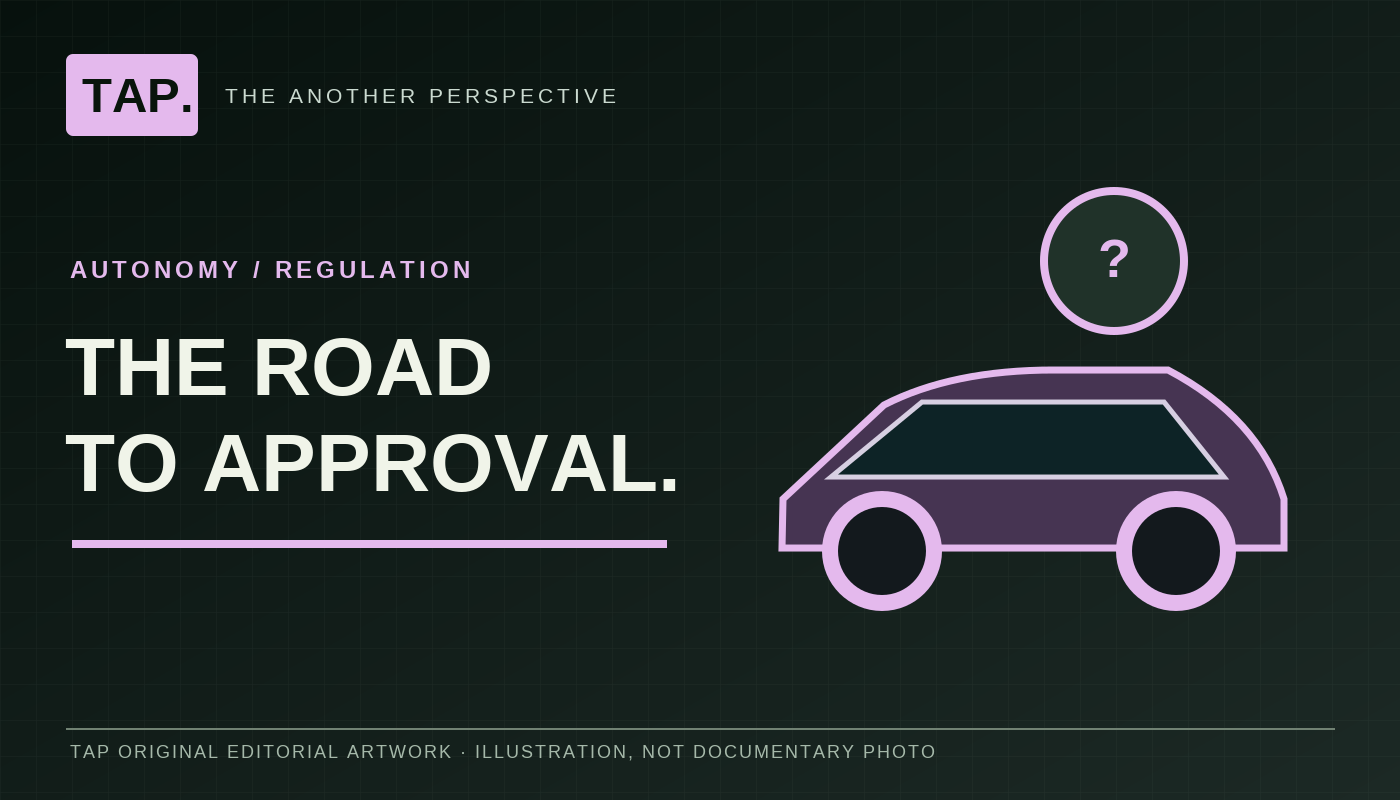
Concept illustration of the approval gap, not a photograph of a Tesla Cybercab or proof of production delivery. · TAP original editorial artwork
Tesla says it wants to begin selling its Cybercab robotaxi to customers before the end of 2026. That sounds like a conventional product launch until one detail changes the equation: the two-seat autonomous car is designed without a steering wheel or pedals, the controls normally assumed by much of the road-vehicle safety system.
During Tesla's October 21 earnings discussion, engineering executive Lars Moravy outlined a limited customer-delivery target. Reuters and TechCrunch reported the goal alongside a continuing US federal inquiry into how the unusual vehicle complies with safety requirements. The company can build a prototype and set a sales target. It still has to satisfy the rules governing what enters public roads.
A customer-sale target is not a confirmed launch
Moravy said the company intends to start small with Cybercab deliveries, learning as it goes about ownership, delivery and managing fleets. Existing production, according to Tesla's account of the call, is primarily intended for its own robotaxi operations. That is materially different from announcing an established retail distribution network with public, confirmed delivery dates.
Tesla's CEO Elon Musk emphasized the role of the Cybercab as a transport service vehicle. The economic promise is not necessarily that every consumer will own a robotaxi but that autonomous vehicles may carry paying passengers for much of the day. Selling some units to outside customers and operating a company-owned fleet are compatible ambitions, but they have different requirements and very different revenue models.
Why removing the steering wheel makes the regulation harder
The Cybercab's distinctive feature is that it was designed to operate without an ordinary human driver's controls. Reuters described the gold, two-seat vehicle as lacking steering wheels, pedals and mirrors. US vehicle standards, however, were developed around traditional assumptions about occupants and driver operation, which creates a certification question for manufacturers.
The National Highway Traffic Safety Administration opened an inquiry about how Tesla's Cybercab vehicles were certified under existing federal rules. As of the October 21 reporting, Tesla had a deadline of October 30 to respond. An investigation is not a final finding of wrongdoing, and a planned rule change is not the same thing as a completed legal exemption or certification.
Even beyond vehicle design rules, a robotaxi operator must address practical service concerns: where and under which local authorizations the cars operate, who intervenes when they encounter unusual conditions, and what happens when the system cannot complete a journey. None of those challenges disappears when production volume increases.
Four milestones that should not be confused
First, a company can demonstrate that a vehicle drives autonomously under particular conditions. Second, it can manufacture vehicles at a factory. Third, it may need to establish compliance with the laws for selling and registering those vehicles. Fourth, it has to prove that the operation of a paid driverless service is safe and permitted where the rides take place. Announcing progress on any one milestone does not establish success at the other three.
Tesla's launch narrative sometimes compresses these steps into a single promise: robotaxis are coming. A better way to evaluate progress is to look for separate evidence of units sold, registrations or approvals where applicable, safety performance data, and paid rides under specific operating conditions. Without those distinctions, investors and prospective buyers risk confusing the company's roadmap with a finished deployment.
Why the distinction matters for Tesla's business model
Tesla has increasingly cast its future around artificial intelligence and robotics rather than just conventional electric vehicle sales. An autonomous vehicle that operates without a paid human driver could, if technically reliable and legally authorized, alter the economics of local transportation. That remains a conditional business case, not a demonstrated financial outcome.
Tesla's October 2026 earnings discussion gave analysts another near-term date to measure. But the regulatory inquiry illustrates an important asymmetry: factories can be scaled according to an engineering schedule, while vehicle certification and public safety approval depend on external institutions. Those timelines need not move together.
There is also a distinction between the Cybercab and Tesla's familiar Model 3 and Model Y. Adding driver-assistance features to cars with human controls does not automatically answer the legal and operational questions surrounding a purpose-built vehicle that omits them entirely.
What to watch next, instead of another promise
The immediate checkpoint is Tesla's response to US regulators by the reported October 30 deadline, and any published agency decision that follows. Then come public evidence of any initial customer deliveries, the terms under which vehicles are sold, where they are registered, and the specific services for which they are authorized. Each is more informative than an unchanged calendar target.
Independent safety information will also matter. Demonstrating a commercial robotaxi service requires evidence about failures and unusual road conditions, not merely confident statements about the pace of manufacturing. Neither a federal inquiry nor a company target by itself settles the issue.
The TAP perspective: the bottleneck may not be the factory
The most interesting part of Tesla's promise is not its date. It is the gap between what software and factories can produce and what public roads can safely accept. A steering-wheel-free car makes that gap visible.
The Cybercab story will be decided by more than whether Tesla produces a vehicle before December ends. It will be decided by whether Tesla can show a legally compliant and consistently safe way to put it to work. Until those milestones are independently documented, year-end sales remain a company objective, not a settled outcome.