· 4 min read
Astronomers Found a July Sky That Matches The Starry Night. Art Historians Aren't Convinced
A peer-reviewed reconstruction suggests Van Gogh observed a specific predawn sky in July 1889, but museum records and independent critiques challenge the new date.
By TAP Desk
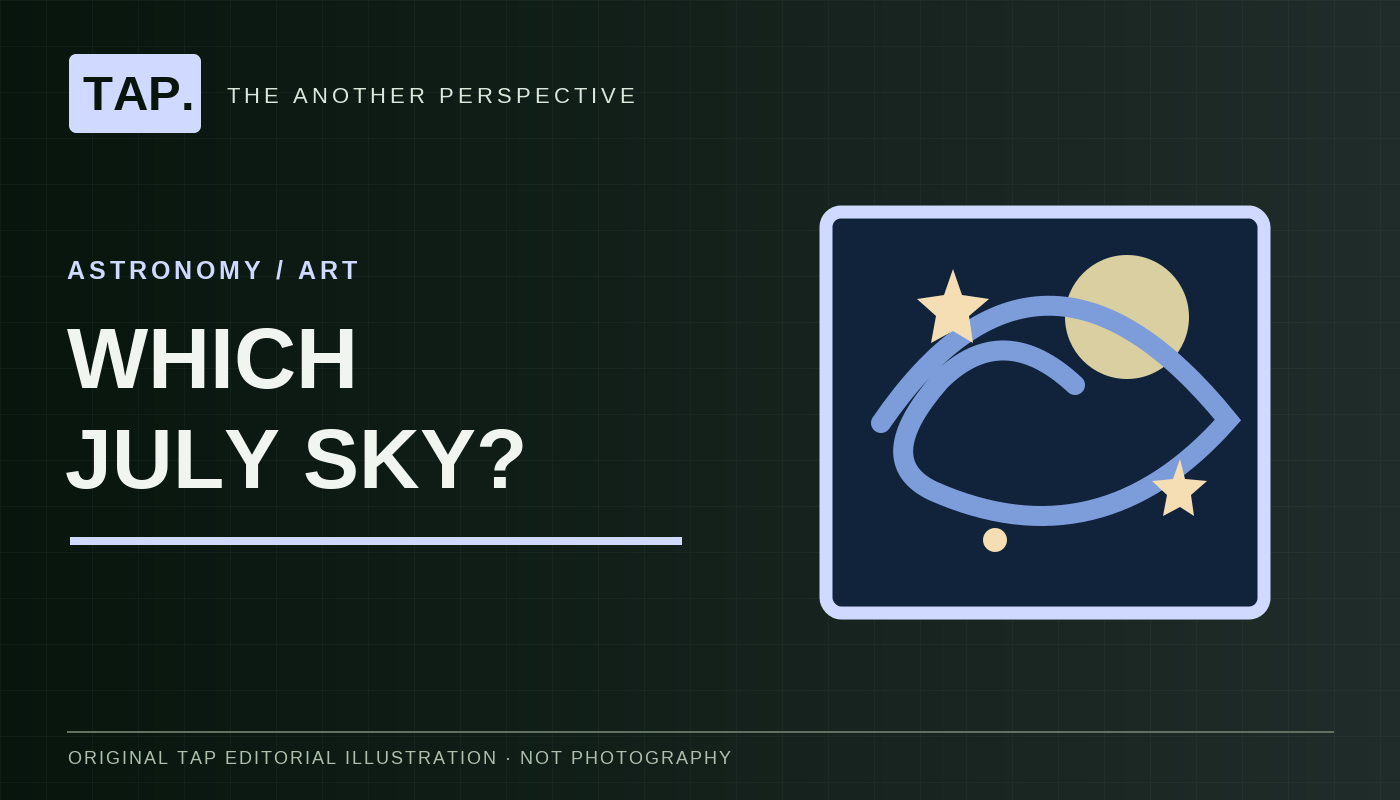
Original symbolic night-sky artwork, not a reproduction of Van Gogh's The Starry Night or a verified July 1889 star map. · TAP original editorial artwork
One of the most recognizable painted skies in the world may resemble the real predawn sky over southern France on a particular morning in 1889. A research team used astronomy, historical weather records, landscape geometry and Vincent van Gogh's letters to argue that The Starry Night reflects a celestial arrangement visible around July 22 of that year.
The idea is fascinating because the painting is often discussed as a powerful expression of imagination and emotion. But the new research, published on October 22, does not settle when the artist completed the work. The Van Gogh Museum argues that documentary evidence places the painting in June, and independent astronomers have questioned parts of the new calculation.
The clue is the relationship between the Moon and Venus
The researchers reconstructed a narrow view of the predawn horizon near Saint-Rémy-de-Provence, where Van Gogh lived in an asylum in 1889. They looked at how the Moon, bright Venus and the Hyades star cluster would have appeared relative to one another in June and July. Their calculations suggest a particularly close resemblance to the painting around July 22.
The team did not simply match stars by eye. Its paper describes geometric comparisons, terrain observations, historical weather conditions and tests involving other paintings. That makes the proposal more than a social-media claim that someone discovered the exact night. It is a testable attempt to connect the composition with the physical sky the artist might have observed.
Why the historical record points the other way
The Van Gogh Museum has challenged the revised chronology. It cites the roll of canvas the artist received in early June and a drawing connected to the painting that he had sent to his brother Theo by July 2. Those records make it difficult to claim the entire finished work was first created from observations on July 22.
The museum has also emphasized Van Gogh's artistic method: he did not treat painted celestial positions as a scientific chart. The work could incorporate observation, memory, invention and deliberate changes in scale. A plausible sky alignment therefore may explain some visual details without proving that the artist was looking at that exact configuration while completing the canvas.
Even astronomers disagree about the reconstruction
Critics quoted by independent news organizations have raised questions about the size of the assumed field of view and the placement of Venus and the Hyades. A narrower frame can make one group of stars fit a painting, but the full landscape may imply a broader view. Altering that assumption can change how persuasive the match appears.
The researchers acknowledge uncertainty and the possibility of several observed skies feeding into one painting. That matters because the historical and astronomical arguments do not answer precisely the same question. Astronomy can establish what was visible on a date. Letters and drawings provide clues about when the artist had already begun or completed particular stages of the work.
What a disputed date reveals about art and science
The attraction of the July theory is not only a new calendar entry. It suggests Van Gogh may have looked closely at a real sky before translating it into the swirling, exaggerated forms now familiar to viewers. Even if the exact July date is not accepted, astronomical comparison can contribute to understanding his observation of nature.
Scientific reconstruction is most useful here when its assumptions are visible and its claims remain modest. Likewise, art historians should not dismiss astronomical evidence merely because it differs from a traditional dating convention. The productive debate is about how different forms of evidence can illuminate the same object without pretending all uncertainty has vanished.
The TAP perspective: reality and imagination need not be rivals
The painting's value does not depend on whether the stars can be attached to one morning in 1889. A real arrangement could have inspired the sky, while color, rhythm and composition remained Van Gogh's artistic choices. The fact that a scientist can compute a possible alignment does not turn the artwork into a photograph.
The more interesting perspective is how two types of investigation can challenge each other. The telescope supplies a possible sky. Letters, sketches, museum records and the physical canvas constrain the chronology. The strongest answer may be a carefully qualified account of observation and creative transformation, not a dramatic proclamation that the world's most famous night sky has finally been solved.