· 6 min read
Brazil is choosing a president. It is also choosing how it deals with the world.
Nearly 159 million Brazilians are eligible to vote in a polarized presidential election between Luiz Inácio Lula da Silva and Flávio Bolsonaro. The contest is domestic, but the consequences reach Washington, Beijing and the future of Latin America’s largest economy.
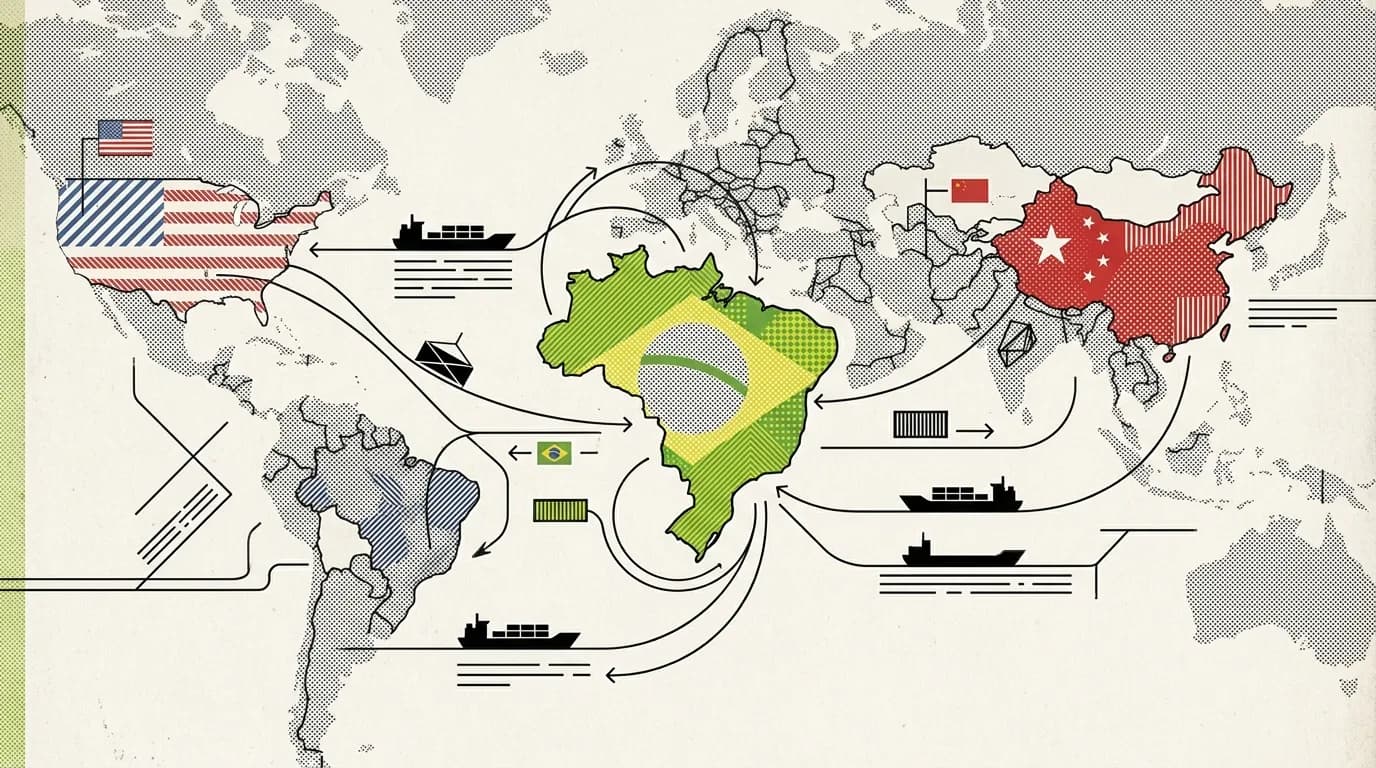
Fig. — A balancing act.
Brazil’s presidential election is easy to describe as a familiar political fight.
On one side is President Luiz Inácio Lula da Silva, the veteran left-wing leader seeking another term. On the other is Senator Flávio Bolsonaro, the son of former president Jair Bolsonaro and an ally of U.S. President Donald Trump.
But the election is bigger than a family name versus a political dynasty.
Nearly 159 million Brazilians are eligible to vote. If no candidate wins more than half the vote, the two leading candidates will face a runoff on October 25.
For Brazilian voters, the immediate questions are domestic.
Affordability has become a major problem. Crime and public security remain central. Both leading candidates carry political baggage, and the country is still living with the polarization that defined the last presidential election.
A choice that travels
Yet Brazil is also a country whose choices travel.
It is Latin America’s largest economy, a major agricultural exporter, a large energy producer and one of the most important emerging-market voices in global diplomacy.
That makes the candidates’ external relationships matter.
Flávio Bolsonaro has emphasized his proximity to the Trump administration and argued that Brazil should seek better deals with Washington. The relationship also has a personal dimension: his father is serving a prison sentence after being convicted over an attempted coup, and the younger Bolsonaro has campaigned on freeing him and bringing him back into politics.
Lula has taken a more confrontational posture toward Washington while strengthening ties with Beijing. He has framed some recent U.S. pressure on Brazil as interference and positioned the country as a power that should be able to maintain strategic independence.
China matters because it is deeply embedded in Brazil’s trade. The United States matters because of finance, investment, diplomacy and security. Brazil has reasons to work with both.
That is why the foreign-policy question is not simply, “Which side will Brazil choose?”
A more realistic question is, “How much room can Brazil preserve between them?”
The election also arrives at a moment when critical minerals have become strategically valuable. Flávio Bolsonaro has pointed to Brazil’s mineral resources as an area for deeper U.S. cooperation.
None of that means voters are walking into polling stations thinking mainly about geopolitics.
Most elections are decided by ordinary concerns: jobs, prices, public services, safety and trust.
But once the ballots are counted, the winner will inherit a country whose economic weight makes even domestic political choices international.
Brazil is not choosing between being pro-American or pro-Chinese.
It is choosing the person who will decide how Brazil uses its size when both powers want more from it.
Sources & References
How TAP sources stories →- 01AP ↗