· 7 min read
Microsoft Offered 60,000 Workers a Way Out. That Doesn't Mean 60,000 Jobs Were Cut.
Microsoft says tens of thousands of staff can apply for voluntary departure support. The number describes eligibility, not confirmed exits or jobs replaced by AI.
By TAP Desk
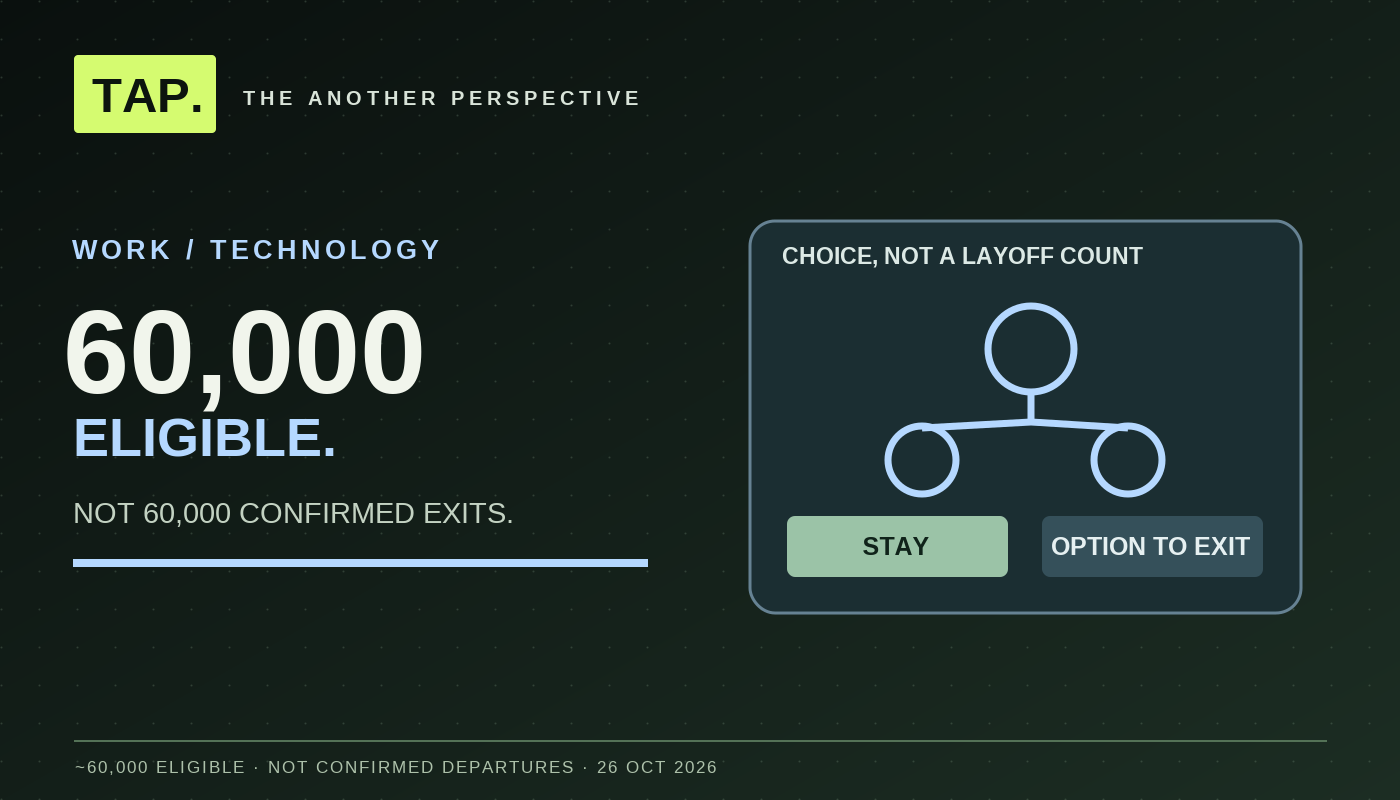
Eligibility count, not layoffs or workers known to have left. Microsoft's October 26 memo and independent confirmations. · TAP original editorial artwork
Microsoft has offered a new departure option to approximately 60,000 employees, a number large enough to invite instant comparisons with mass layoffs. The company announced the voluntary program on October 26 as it pours money into AI infrastructure and reshapes parts of its workforce. Yet one central distinction gets lost when eligibility is confused with job losses: 60,000 people were not announced as having left Microsoft.
The company calls the program a Voluntary Exit Offer. Employees in participating teams can choose whether to accept time-limited financial and career support. The business context matters, but the official memo cannot tell us how many people will take the offer or how their work would be reorganized afterward.
Who is eligible—and who is not
Microsoft chief people officer Amy Coleman published the offer on the company's official blog. It applies to eligible staff at level 70 and below in participating teams across the United States, Canada, India and the United Kingdom. Coleman stressed that some parts of the company are participating and others are not, depending on business priorities and customer commitments.
Reuters and other outlets reported company confirmation that roughly 60,000 staff fall within the eligible group, about 27% of Microsoft's approximately 223,000 workers as of June. That calculation describes the population offered a choice. It is not a forecast of actual departures, a budget saving already recorded or an involuntary reduction affecting every eligible employee.
Microsoft says the offer is voluntary and time-limited, with financial support and career-planning resources. The detailed economics vary by role, location and tenure. An individual's decision to accept one of these packages cannot be inferred from the company-wide number.
The significance of the word voluntary
A conventional layoff removes a position or terminates employment according to employer decisions and legal processes. A voluntary exit offer gives eligible workers the ability to choose a departure package, usually within conditions set by the employer. The two may both shrink a workforce, but the decisions, incentives and lived experiences differ.
Not everyone who qualifies will accept. Some may consider the package attractive because they were already planning a career change. Others may prefer to stay, seek internal transfers or decide the terms are insufficient. Until Microsoft reports actual acceptances, a headline that says it has 'cut 60,000 jobs' is wrong.
This distinction does not make a voluntary program unimportant. A large offer can change how teams plan projects and how remaining employees judge organizational priorities. But it should be evaluated from actual participation, specific business units and later staffing figures rather than from the headline eligible population.
Where AI spending enters the story
Microsoft is investing heavily in cloud infrastructure and AI products, while shareholders and customers are asking whether that spending will translate into durable revenue. Analysts naturally consider whether workforce changes might help fund those investments. But the official announcement uses a broader explanation: participating teams need flexibility to adapt to changing organizational requirements.
It does not identify 60,000 positions as made redundant by Copilot, automated coding or a particular AI system. Reuters reports that eligibility includes teams involved with AI experiences and Copilot as well as corporate functions. Participation of an AI-related team is not evidence that the technology replaced the staff in that team.
Workforce decisions can also reflect restructuring, product demand, management changes, geographic priorities and the costs of operating an international company. Serious analysis should not force every large headcount figure into a single explanation simply because AI is central to the wider technology economy.
What we know from Microsoft's earlier programs
Coleman said the new offer builds on a voluntary retirement program conducted earlier in 2026. The company has also made separate workforce reductions. Those earlier actions provide historical context, but they should not be added to the 60,000 eligible employees as though all numbers describe completed layoffs in a single event.
Some previous retirement offers attracted meaningful participation, but that does not establish an acceptance rate for this program. Different employees, compensation packages and economic conditions can produce different results. An estimate that multiplies an earlier take-up rate by 60,000 would be a scenario, not a confirmed departure count.
The company says eligible employees will receive direct details. Labor-market implications will become clearer only after employees have made their decisions and Microsoft reports workforce changes. In the meantime, the strongest public evidence is the memo itself and the independently confirmed eligibility figure.
The harder question is what work remains
The story does not end when departing workers take a package. Customers still need reliable products and support. Companies still need engineers, sales staff, security teams and the organizational knowledge that lets teams respond when systems fail. A reduction that improves efficiency in one unit could create unexpected bottlenecks elsewhere.
AI tools can help people produce software or content faster, but measuring their net labor effect requires more than anecdotes and a company-wide exit offer. Businesses must distinguish tasks accelerated by tools from roles truly eliminated, outsourced, reorganized or newly created. That accounting remains difficult, especially when firms are changing products and infrastructure at the same time.
Workers considering voluntary packages also have practical questions about benefits, vesting, tax treatment, legal rights and alternative employment. Those terms are individualized and should be reviewed directly. An attractive company announcement does not substitute for a personal understanding of the offer.
The TAP perspective: measure exits, not eligibility
Microsoft has given about a quarter of its global workforce an option, not announced the departure of a quarter of its employees. That is a significant organizational move, but its eventual scale is unknown. Language that protects this distinction makes the story more useful to workers and investors alike.
The more important follow-up will ask how many employees actually accept, what teams are changed, whether projects continue and how AI-related investments affect operating results. That evidence could support several different interpretations, and reporting should remain open to them.
Until then, the right headline is not that AI has replaced 60,000 workers. It is that Microsoft is testing a large voluntary transition program during a period of rapid technological and financial change.