· 5 min read
Two PHP Flaws Sent Websites Offline. The Real Risk Is What Happens Before They Are Patched
Emergency fixes are available for two critical vulnerabilities in PHP, a technology behind millions of sites. Exploit attempts appeared even before disclosure, and temporary defenses are not enough.
By TAP Desk
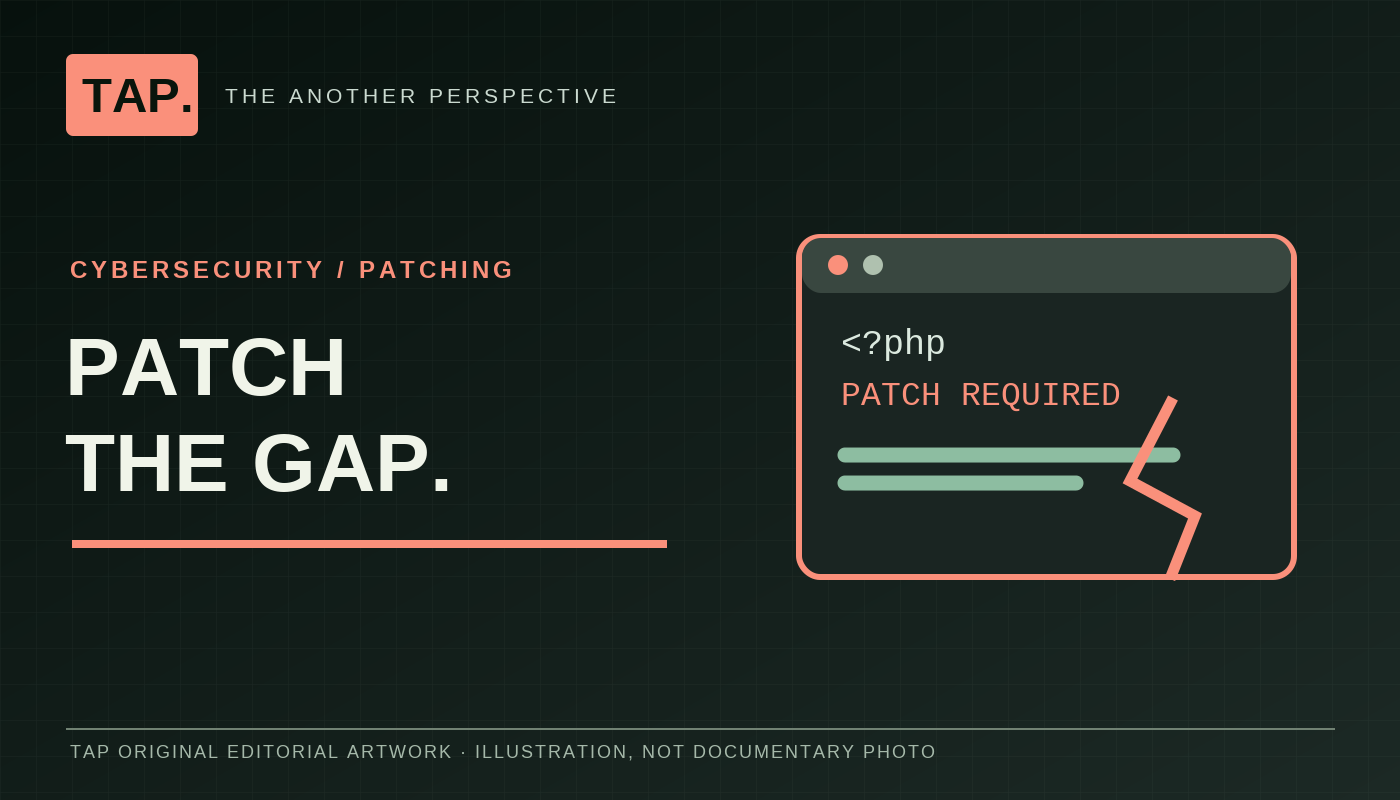
Concept graphic, not actual exploit code, an error log or a vulnerable user's server. · TAP original editorial artwork
A website does not need to be famous to become exposed to a serious flaw. Sometimes all it needs is to run a common piece of software that the visitor never sees. On October 21, 2026, PHP, the server-side language used by a vast range of websites and applications, released emergency fixes for two critical vulnerabilities known collectively as PHP2Shell.
The vulnerabilities, CVE-2026-109618 and CVE-2026-109619, can in certain vulnerable configurations allow an attacker to execute code remotely without first logging in. European cyber authorities urged urgent action, some organizations temporarily disconnected websites, and Amazon security researchers reported exploit attempts that predated public disclosure. These facts describe a severe threat. They do not prove that every site using PHP was breached.
Why a flaw in PHP matters to a website that has never heard of PHP
PHP runs behind the scenes. A business owner might recognize WordPress, an online store, or a hosting control panel without knowing what programming runtime is serving requests underneath. That invisible dependency is precisely why a problem in the underlying language can create a wide operational challenge.
The affected functionality is not a new optional plugin that an administrator can simply disable. The PHP project and CERT/CC describe memory-handling defects in the runtime itself. CVE-2026-109618 concerns the handling of memory after an out-of-memory interruption. CVE-2026-109619 concerns internal state that can outlive the memory backing it. Both received critical ratings of 9.2 on the CVSS v4 scale. Their practical exploitability depends on deployment details, but the exposure cannot be dismissed merely because a site is small.
The patch arrived on October 21. Attack attempts came earlier
PHP published fixed releases on October 21: 8.5.12, 8.4.27, 8.3.36 and 8.2.35. Its security guidance says upgrading is the only complete solution. Operators running older, unsupported PHP branches must plan a migration or obtain a properly maintained vendor-backed solution rather than assume an upstream fix exists.
Amazon Threat Intelligence reported seeing an exploit attempt against its MadPot honeypot on October 17, four days before public disclosure. It also detected attempts on October 21 ahead of the coordinated patch release. That is significant evidence of attempted exploitation, but Amazon expressly said it could not determine whether those attempts would have succeeded on real-world production systems.
The distinction matters because headlines about widespread 'attacks' can conflate probes, proof-of-concept activity and confirmed intrusions. A spike in exploit requests shows urgency. It does not by itself establish the number of compromised organizations.
Why governments took websites offline to protect them
When an organization cannot confirm what version of PHP is installed, whether its hosting vendor has deployed an update, or whether its own application works with the fix, restoring security can take time. European agencies recommended prioritizing internet-facing services and coordinating directly with hosting providers. Reuters documented precautionary shutdowns at public-sector sites as the patching race began.
Taking a service offline may reduce exposure while a critical fix is applied, yet the disruption can prevent people from accessing information they need. It is a security trade-off, not automatic proof that hackers already entered the system. The most consequential weakness may be operational: institutions often know which visible applications they operate but not every hidden dependency beneath them.
What website owners should actually do
First, ask the hosting provider which PHP version is active for each website or application and whether the patched runtime has been deployed. The release numbers to look for are 8.5.12, 8.4.27, 8.3.36 and 8.2.35. Confirm the answer with a recorded version check after maintenance, not merely a statement that a web security plugin is current.
Second, create a reliable backup, test compatibility and deploy the vendor-supported fix as a priority. If the site still runs PHP 8.1 or earlier, treat that as a separate lifecycle risk. Third, review web and application logs for unexpected requests and changes, and coordinate with the provider if suspicious activity appears. Firewall filtering and temporary configuration controls may reduce particular attack routes, but PHP and AWS explicitly caution that these are not complete substitutes for patching.
For WordPress and WooCommerce operators, the practical distinction is between updating the content-management system and updating the PHP runtime on the server. One does not necessarily perform the other. Businesses should verify both, rather than treating a completed plugin update as proof that their hosting stack is protected.
The TAP perspective: the internet depends on software most people never see
The bigger story is not simply that two bugs received alarming severity scores. It is that software shared by unrelated websites can force governments, companies and small businesses into the same emergency at once. The hidden layers of the web are critical infrastructure in practice, even when no one describes them that way.
An effective response therefore depends on knowing dependencies before a crisis, receiving timely vendor updates, and being able to apply fixes without cutting off essential services. PHP2Shell is a reminder that 'website security' is not only about passwords, login screens or malicious emails. Sometimes the risk arrives through the machinery running underneath everything else.