· 6 min read
The AI Superpowers Want Countries to Pick Sides. The Real Test Is Whether They Can Leave.
Washington offers trusted supply chains. Beijing offers wider AI access. For smaller countries, the lasting question is who controls the infrastructure and the exit.
By TAP Desk
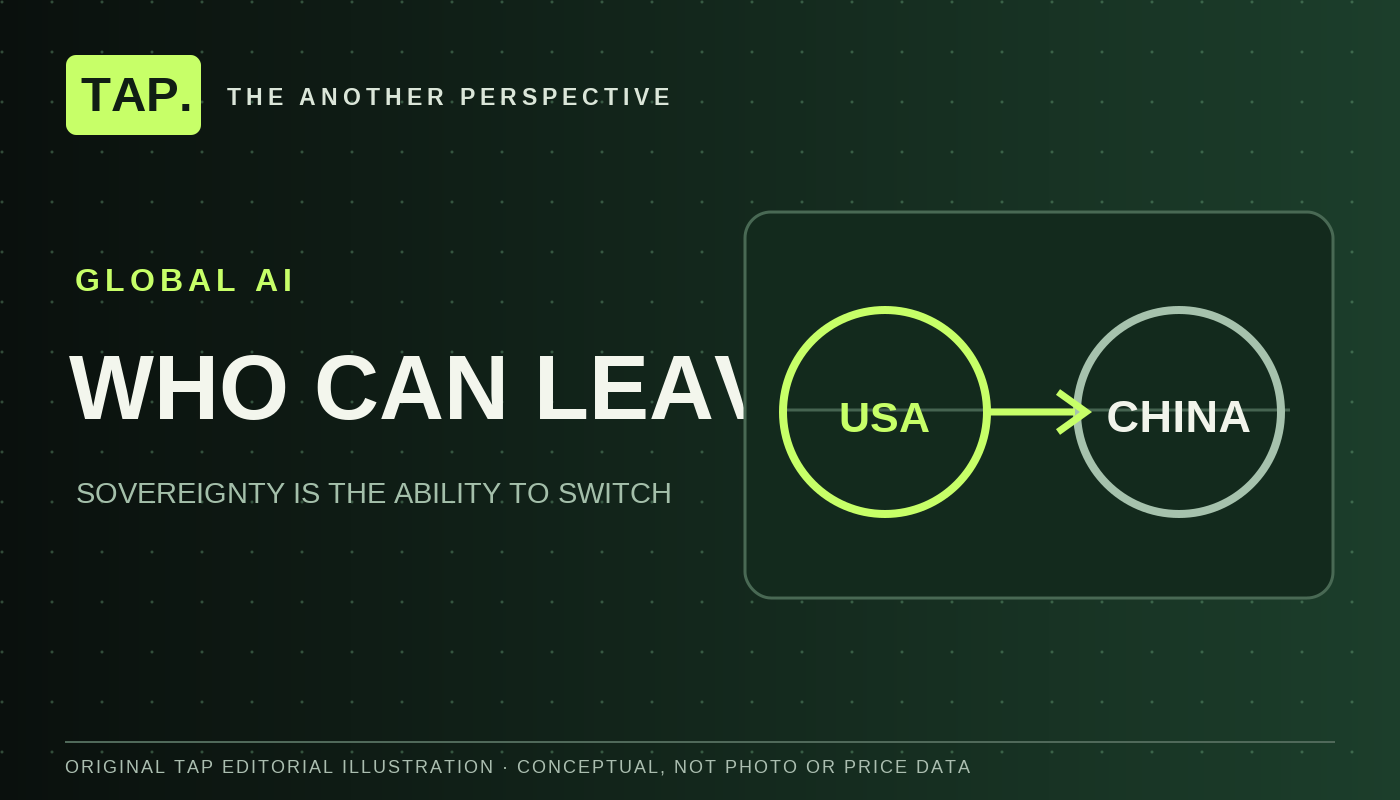
Conceptual diagram, not a map of formal coalition membership or technology supply contracts. · TAP original editorial artwork
An artificial-intelligence strategy is starting to resemble a foreign-policy choice. Governments that once shopped freely for software, chips and research partnerships now face competing offers from Washington and Beijing. One side emphasizes trusted supply chains and access to advanced computing. The other emphasizes wider access, lower-cost models and a seat at the table for countries that do not build frontier AI themselves.
New reporting by the Associated Press on October 25 describes governments trying to participate in both camps. Kazakhstan has joined the U.S.-led Pax Silica initiative and China's World AI Cooperation Organization. Pakistan is among the initial participants in the China-inspired organization, according to AP. These choices are not simply endorsements of one chatbot over another. They could shape who finances data centers, whose chips are available and which institutions write the rules for using AI.
Two coalitions, different promises
Pax Silica began in December 2025 as an American effort to secure the industrial foundations of advanced technology. A March 2026 Council of the European Union document describes its scope as critical minerals, chip design, manufacturing and data-center infrastructure. That is a much larger agenda than software procurement. It connects AI access to electricity, extraction, factories and international supply-chain trust.
China's World AI Cooperation Organization offers a different diplomatic pitch. In an August 2026 speech published by China's foreign ministry, a Chinese ambassador described the organization as a vehicle for capacity building in developing countries and international AI governance. These are official statements of intent, not proof that member countries have received promised benefits. Nor is membership in either initiative, by itself, evidence of a binding obligation to purchase a particular model.
Both governments have legitimate interests in securing technology and preventing misuse. But their preferred architectures can also increase their influence over the choices available to smaller countries. An offer of investment may come with standards, vendor relationships or export-control exposure that become costly to unwind later.
Kazakhstan is testing whether countries can have both
AP reports that Kazakhstan joined the American initiative in June and became a founding participant in the Chinese organization only weeks later. The country has critical minerals and relatively inexpensive electricity, assets that make it attractive to investors building AI infrastructure. AP also describes a potential data-center investment involving Nvidia worth up to $10 billion. Potential is the operative word: a proposed or agreed investment is not the same thing as completed facilities or realized economic returns.
The political risk is that a strategy designed to maximize options may eventually narrow them. In August, Reuters reported on a draft U.S. State Department letter warning partners against participation in competing initiatives. Reuters could not establish whether or when that draft would be sent. The distinction matters. A reported draft is evidence of internal pressure, not proof that every country has received an ultimatum or that formal exclusion rules have taken effect.
By October, however, the State Department told AP that trusted partners could not substantively advance a competing vision for advanced AI while participating in Pax Silica. Beijing, meanwhile, told AP that the technology should not be controlled by major powers alone. Both positions deserve scrutiny: security claims need clear thresholds, and promises of openness need testable access conditions.
The real lock-in is below the chatbot
A ministry can switch from one language model to another faster than it can replace a national data-center network, a cloud contract or a fleet of specialized chips. Training and inference depend on electricity, connectivity, procurement, software tooling, technical skills and reliable maintenance. A low-cost model can still be expensive if it runs on infrastructure a country does not control. A powerful imported chip is not a sovereign capability if future updates, servicing or export permissions can disappear.
That is why an AI partnership should be evaluated in layers. Who owns the hardware? Where is sensitive data processed? Can applications move between providers? Can local engineers audit and maintain the system? Are models usable without a foreign service remaining continuously available? What happens when export rules change or a diplomatic dispute interrupts support?
These questions are not arguments for every country to build its own frontier model. That would be unaffordable and unnecessary for many public services. They are arguments for reducing single points of failure. A government can buy external technology and still negotiate portability, domestic expertise, transparent procurement and contingency plans. The meaningful form of independence is the practical ability to change course.
What the choice means for countries outside the two powers
AP reports that Indonesia wants to benefit from both ecosystems, Singapore is considering participation in China's initiative and Saudi Arabia is combining a Chinese open model with American computing technology. Those examples undermine the idea that all national AI systems must be assembled from one geopolitical supplier. In practice, different sectors can tolerate different risks. A public weather service, a hospital record system and a military intelligence network should not be treated as interchangeable procurement problems.
Pakistan's reported participation in the Chinese initiative makes the question especially relevant for policymakers across South Asia. The public interest is not served by announcing a partnership and stopping there. Governments should publish what they receive, what they commit to, what information may cross borders and what independent technical capacity they will build. Universities and small businesses need affordable access; citizens need enforceable privacy and security protections.
Neither Washington nor Beijing can credibly promise that every partner will always enjoy unrestricted access to technology. National-security restrictions, commercial incentives and changing product strategies are part of both ecosystems. The responsible response is to evaluate each agreement on its merits rather than treating a coalition label as a guarantee of either safety or openness.
The TAP perspective: sovereignty is the ability to leave
The fashionable phrase 'AI sovereignty' can imply that a nation must own everything from a model's training data to the factory that makes its chips. For most countries, that is not a realistic measure of autonomy. A more useful test is whether public institutions retain bargaining power after the contracts are signed. Can they migrate data, audit outcomes, keep essential services running and train people who understand the technology rather than merely operate it?
A genuine partnership should make a country more capable over time, not just more dependent on a new supplier. That means measuring outcomes such as local skills, interoperable infrastructure, energy costs, procurement transparency and resilience under disruption. The United States and China may continue to compete over which ecosystem wins. Countries in between should ask a harder question: after accepting help from either side, will they have more choices than before?