· 6 min read
The World Moved Its Factories. The Coal Smoke Followed.
Factories are moving, exports are rising and Vietnam's coal plants are busier. The carbon cost of supply-chain diversification is harder to move out of sight.
By TAP Desk
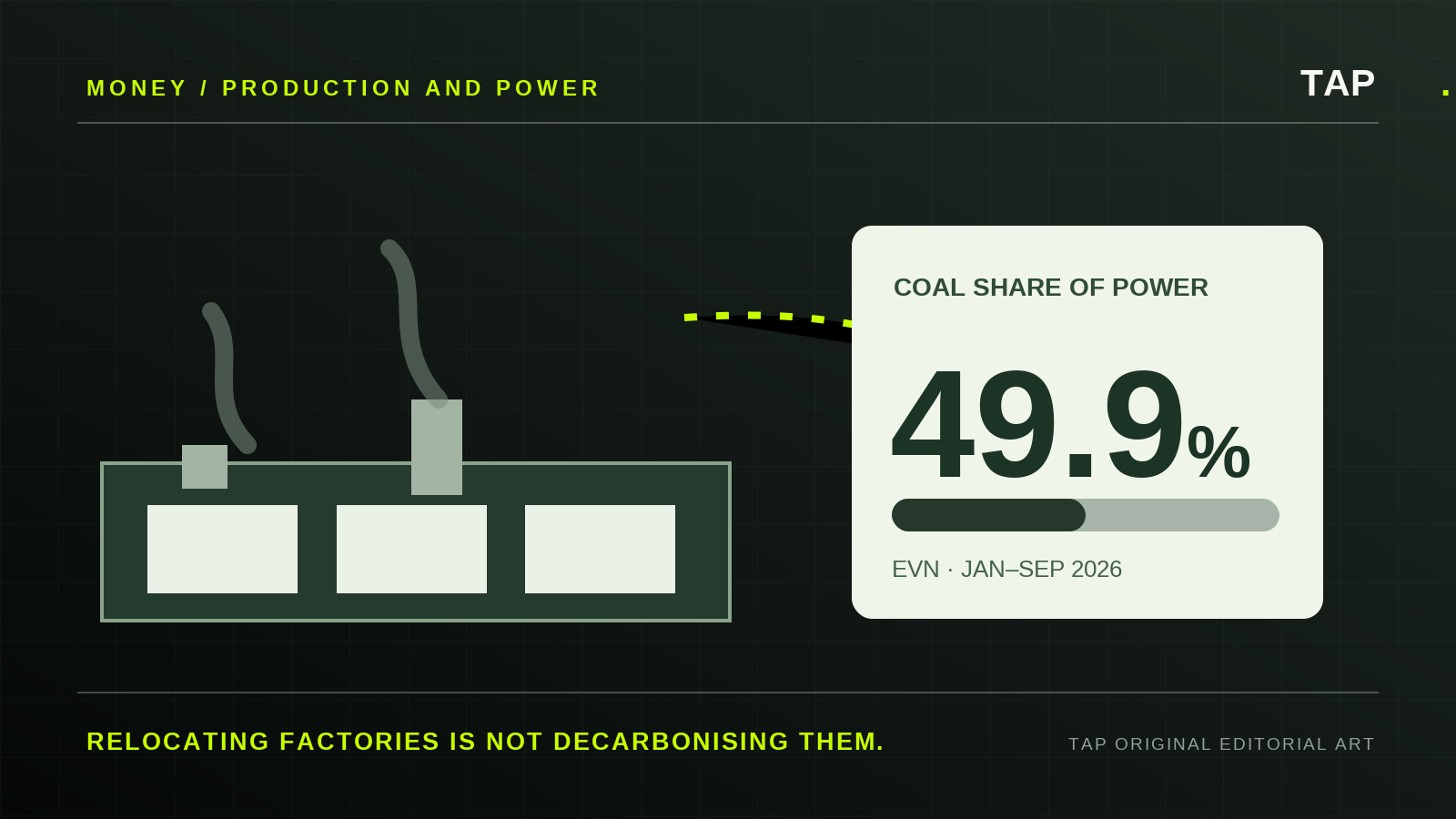
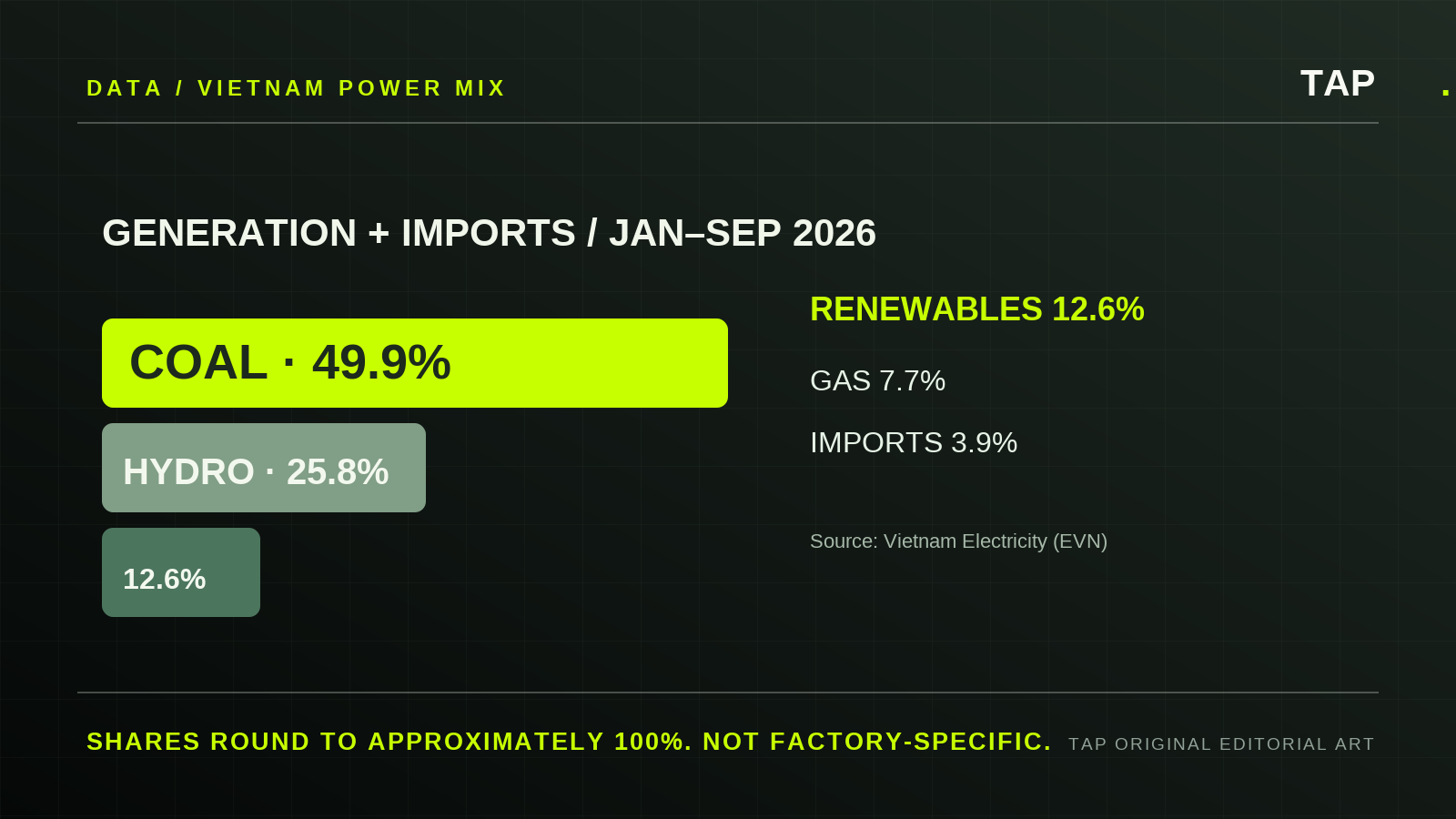
EVN's January–September 2026 generation-plus-imports mix, not electricity usage of any particular factory. · TAP original editorial artwork
A company can move production from one country to another and call the result a more resilient supply chain. The shipping route changes, and so does its exposure to trade restrictions. But the electricity needed to run the machinery does not disappear. Vietnam's rise as an export-production base makes that distinction unusually visible.
Vietnam Electricity (EVN) reported on October 6 that coal-fired generation supplied nearly half of national power generation and imports during the first nine months of 2026. That is a striking energy backdrop to an export boom shaped partly by the US-China tariff dispute. The TAP question is whether supply-chain diversification is being mistaken for environmental improvement.
Start with the electricity denominator
EVN put Vietnam's total electricity generation and imports for January through September 2026 at 265.79 billion kilowatt-hours, 9.3% above the corresponding period last year. Coal supplied 132.63 billion kilowatt-hours, or 49.9% of that combined total. Hydropower supplied 68.48 billion kilowatt-hours (25.8%) and renewables supplied 33.6 billion kilowatt-hours (12.6%). VnEconomy independently reported the figures after the utility's release.
Those shares are not a measure of how much coal any particular export factory uses. EVN's national statistics combine generation and imports. Energy-data publisher Ember also maintains monthly global datasets, but the presence of a dataset is not a separate verification of an unpublished facility's electricity contract. Figures from different sources require consistent dates and denominators before they are compared.
· TAP original editorial artwork
Changing an export label does not remove China from the supply chain
Research published by the US Federal Reserve in July examined the effects of the 2018–19 American tariff increases on Vietnamese manufacturing. The authors found evidence of stronger exports to the US alongside a rising role for Chinese-owned firms, many of which continued to purchase intermediate inputs from China. Geographic relocation and commercial independence were not always the same thing.
A September analysis published by LSE Business Review reaches a similarly nuanced picture from firm-to-firm transaction research: some activity represented transshipment, while other activity was genuine Vietnamese processing using imported components. These channels operated differently over time. Neither finding proves that every factory moved because of tariffs, and neither measures the emissions of each finished product.
The power system is a separate constraint
Whatever the ownership of a factory, machines and industrial buildings need reliable electricity. Demand growth has to be met by generating plants, grid capacity, flexible resources or imports. A country can attract investment faster than its power system changes. Where coal is a large part of the power mix, rising demand creates pressure to use existing fossil-fuel capacity while cleaner options are expanded.
EVN also reports grid-construction work and plans involving battery energy storage. That matters because a fair account should not portray Vietnam as doing nothing to change its energy system. The numbers describe the current balance of production and imports, not a forecast that coal must keep growing forever.
There is a difference between a greener product and a different supplier
Two companies may assemble similar goods in different countries but face very different electricity mixes and component supply chains. Relocating the final assembly line does not automatically cut the emissions associated with mining, refining, manufacturing and transport. Nor does a coal-heavy national grid prove that a particular facility has no low-carbon power arrangement.
A useful supply-chain assessment asks which sites manufactured each major component, what electricity supplied those sites, and whether verified efficiency or cleaner-energy purchasing changed emissions per product. Those are harder questions than counting exports or announcing a new plant, but they are the measures that would substantiate a climate benefit.
The global trend does not tell every country's story
Ember's Global Electricity Review 2026 reported that renewable energy overtook coal in worldwide electricity generation in 2025. That is a global milestone rather than a description of Vietnam's current mix. Regional conditions, legacy assets, financing costs, demand growth and the pace of grid investment differ substantially.
Vietnam's published nine-month figures show how an expanding industrial economy can still depend heavily on coal even as the world's total mix shifts. Readers should resist comparing a global percentage with a national generation-plus-import statistic as if they were measuring the same thing.
The TAP perspective: follow the power, not only the factory
Diversifying a supply chain can be a sensible response to trade and geopolitical risks. But it is not interchangeable with decarbonising that supply chain. The stronger claim requires evidence about the electricity and materials used to make the goods, not just the flag printed on the shipping documents.
Importing companies, investors and host-country planners all influence the outcome. A balanced approach should recognise Vietnam's development priorities and energy-security needs while asking for transparent, comparable carbon information. The right question is not simply where a factory moved. It is what powers it, and whether that is changing.