· 4 min read
When Your AI Agent Makes a Bank Transfer You Didn't Want, Who Pays?
Wells Fargo's upcoming agreement explicitly addresses autonomous agents, shifting responsibility for some authorized-agent actions to the customer while retaining legal limits.
By TAP Desk
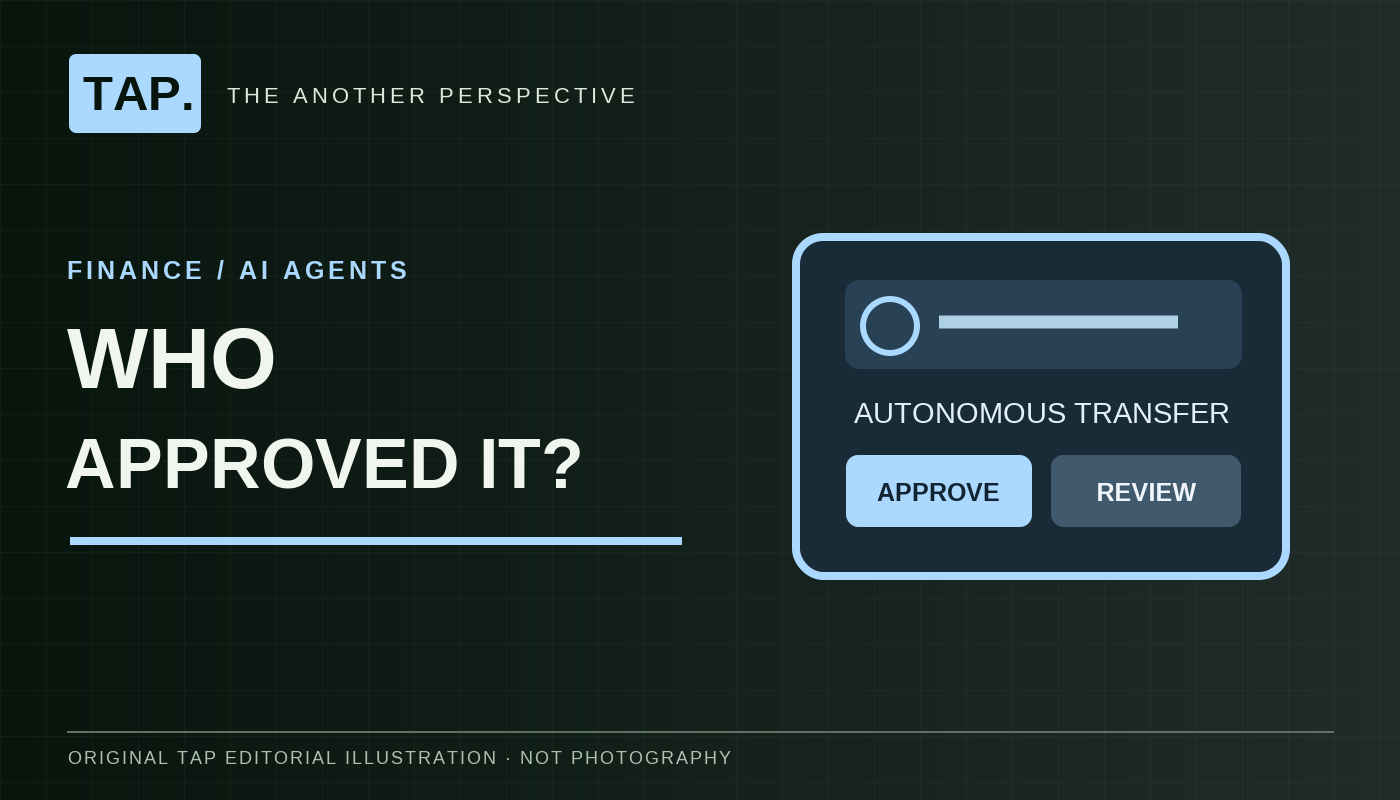
Conceptual authorization graphic, not a genuine Wells Fargo interface or an actual transfer. · TAP original editorial artwork
Imagine asking an AI assistant to manage a bill, then discovering it made a transaction you never intended. Who is responsible: the software company, the bank or the person who enabled the agent? As automated assistants move closer to real financial accounts, that hypothetical question is becoming part of banking contracts.
Wells Fargo's publicly available agreement scheduled for November 24, 2026 explicitly addresses third-party AI agents. The document says customers who permit an agent to act through their account may, within legal limits, bear responsibility even for unintended transactions. That is a significant allocation of risk. It is not evidence that banks have opened their systems to any chatbot that asks.
A bank is drawing a line between permission and intention
Traditional online banking treats login credentials and approved delegates as strong indicators of permission. An AI agent changes the practical meaning of that approval, because it can interpret a broad instruction, choose intermediate steps and act without seeking confirmation for every detail. A customer may have authorized the technology to act while disagreeing with a particular transaction.
The upcoming Wells Fargo agreement says instructions made by an authorized AI agent can be treated as customer-authorized. It also says the bank may rely on those instructions without independently investigating their scope. These statements describe the bank's proposed contractual allocation of responsibility. They must be read alongside legal protections that cannot necessarily be waived by contract.
Why access method matters
An agent might interact through an official, narrowly scoped connection that allows it to read balances or initiate only specified tasks. Or a customer might give an automated tool full login credentials, enabling it to use an account much as the customer would. Those are not equivalent risk arrangements, and banks may limit or prohibit particular routes of access.
Axios and Reuters have reported that banks are detecting or blocking unauthorized agent access. The presence of a bank policy does not mean all third-party AI agents are now welcome. The Wells Fargo wording reserves the right to limit, change or terminate access methods, including through APIs, and it addresses customer responsibilities if the account holder permits a third party to act.
The consumer protection question remains open
An agent that follows a user's instruction badly is different from someone who steals credentials or a service that acts entirely without consent. That difference can affect liability for a disputed transaction. Federal and state consumer protections, account type, timing of notice and the facts of the authorization can all matter.
The upcoming terms expressly include exceptions where law provides otherwise. That is a crucial qualification. A headline asserting that customers are automatically liable for every AI-related loss would be too broad. The right questions are what authority the customer gave the agent, which transactions were foreseeable and whether the bank offered controls that made the authority clear.
What banks and customers could do better
Banks can reduce ambiguity by offering limited permissions, transaction ceilings, separate approval steps for payments and a clear way to revoke access. An agent might be excellent at sorting transactions or preparing instructions without being allowed to move money without final confirmation. Good product design can make those distinct modes understandable.
Customers should be cautious about giving banking passwords to unapproved automation tools, especially those that can initiate transfers. Revoking an agent's permission should be verifiable, not buried in several unrelated settings. A technical permission system that cannot show what an agent is allowed to do makes the contract dispute much harder after an error.
The TAP perspective: autonomy needs a new definition of consent
The innovation promised by agents is freedom from constant supervision. The risk is that broad freedom can turn into actions the user neither anticipated nor understood. Repeating that a customer 'authorized' a transaction does not settle whether the interface provided meaningful control over the system's decisions.
As agentic tools become more capable, the durable competitive advantage for financial institutions may not be granting unrestricted access. It may be making limits, logs and reversal procedures reliable enough for people to delegate tasks confidently. That is how automation becomes a useful service instead of a new source of banking disputes.