· 8 min read
What is chirality? Start with your hands, then shrink the idea to a molecule.
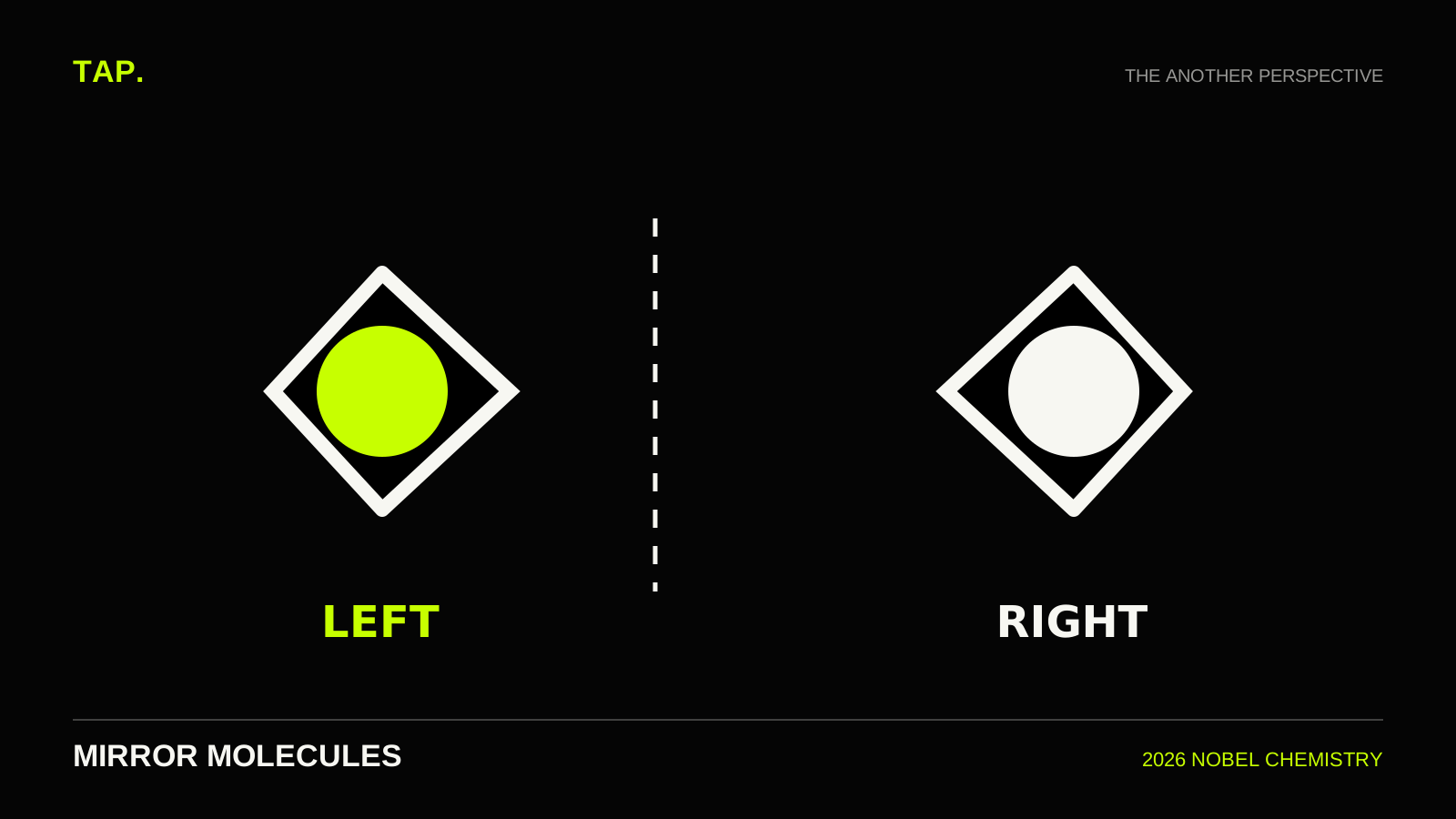
Chiral molecules come in mirror-image forms that cannot be perfectly superimposed, much like left and right hands. That simple geometric property helps explain why smells, enzymes and medicines can respond differently to molecules with the same formula.
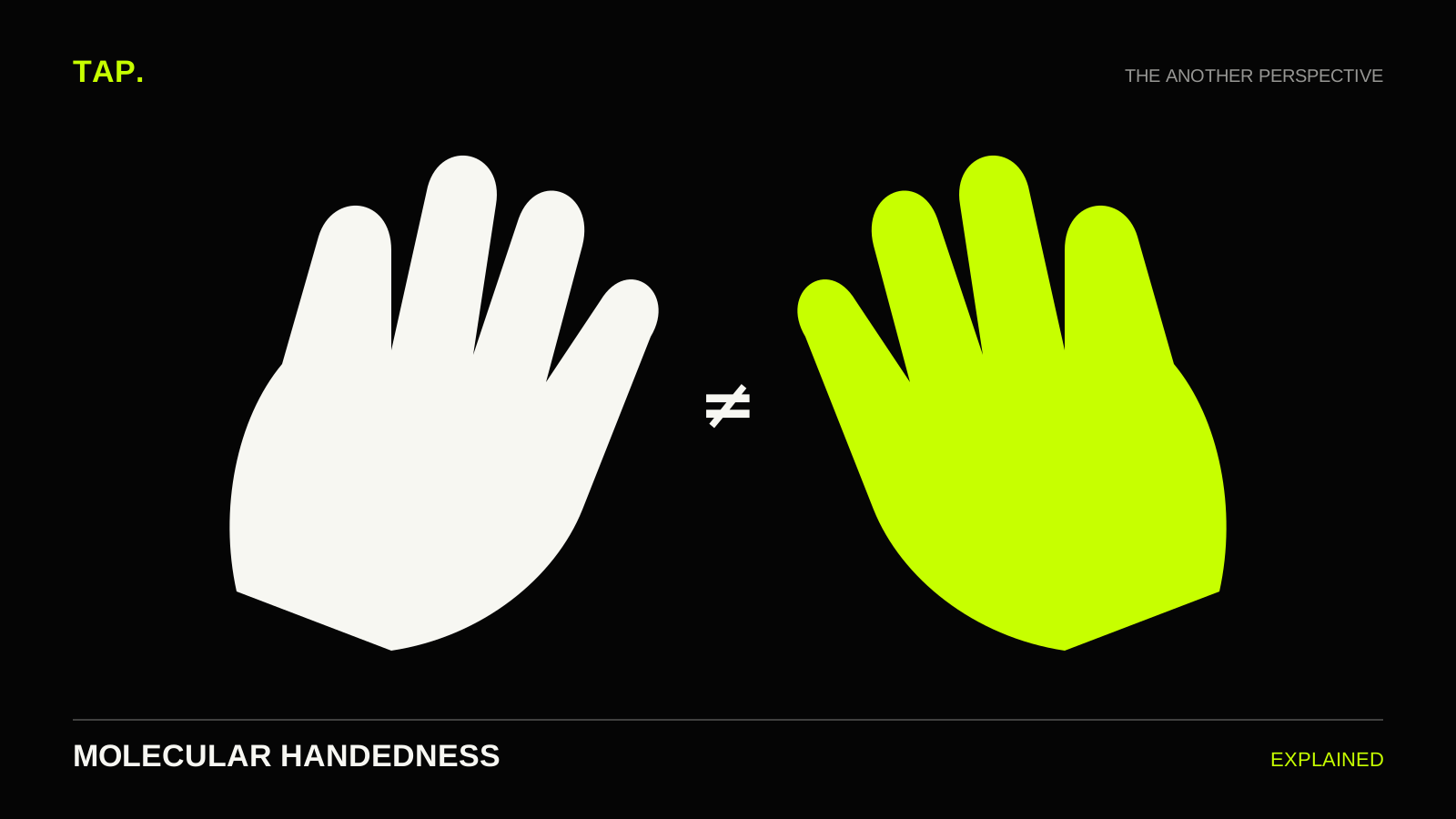
Fig. — Same parts, different orientation.
Put your palms together. Your hands match in broad structure: four fingers, a thumb and the same basic arrangement.
Now try to place your left hand directly on top of your right so every part occupies exactly the same space. You cannot.
That is the intuition behind chirality.
The basic definition
A chiral object is not superimposable on its mirror image. In chemistry, that often happens when atoms are arranged around a central atom in a three-dimensional pattern that can exist in two mirrored versions.
Those two versions are called enantiomers.
Same formula does not mean same behavior
Two enantiomers contain the same kinds and numbers of atoms. Their chemical formula can be identical.
The difference is spatial orientation.
That orientation matters because biological molecules are three-dimensional too. An enzyme or receptor can interact strongly with one enantiomer while interacting differently with the other.
Smell gives an easy example
The molecule carvone exists in mirror-image forms. One is associated with a mint-like smell and the other with caraway.
Your nose is not reading a chemical formula. Receptors are interacting with a three-dimensional molecule.
Why drugs care about handedness
Many medicines are chiral. If only one enantiomer provides the desired biological effect, chemists want a manufacturing route that produces that form selectively.
That is why asymmetric synthesis became such an important field. Instead of making both mirror forms and separating them later, chemists try to guide a reaction toward the form they want from the beginning.
Why life itself is asymmetric
Biology shows strong preferences for molecular handedness. Proteins are built mostly from one handed form of amino acids, while DNA has a characteristic handed structure.
Exactly how early life developed this strong preference remains an important scientific question.
Chirality is a geometry lesson with consequences
At first glance, the topic sounds like abstract organic chemistry.
In practice, chirality affects how a molecule smells, how an enzyme recognizes it, how a medicine interacts with a receptor and how efficiently a factory can produce a useful compound.
The shape is tiny. The consequences are not.