· 9 min read
Why do AI data centers use so much electricity?
AI computing concentrates thousands of power-hungry chips in facilities that run continuously. The electricity demand comes from computation, memory, networking, cooling and the simple fact that useful AI services have to answer requests all day.
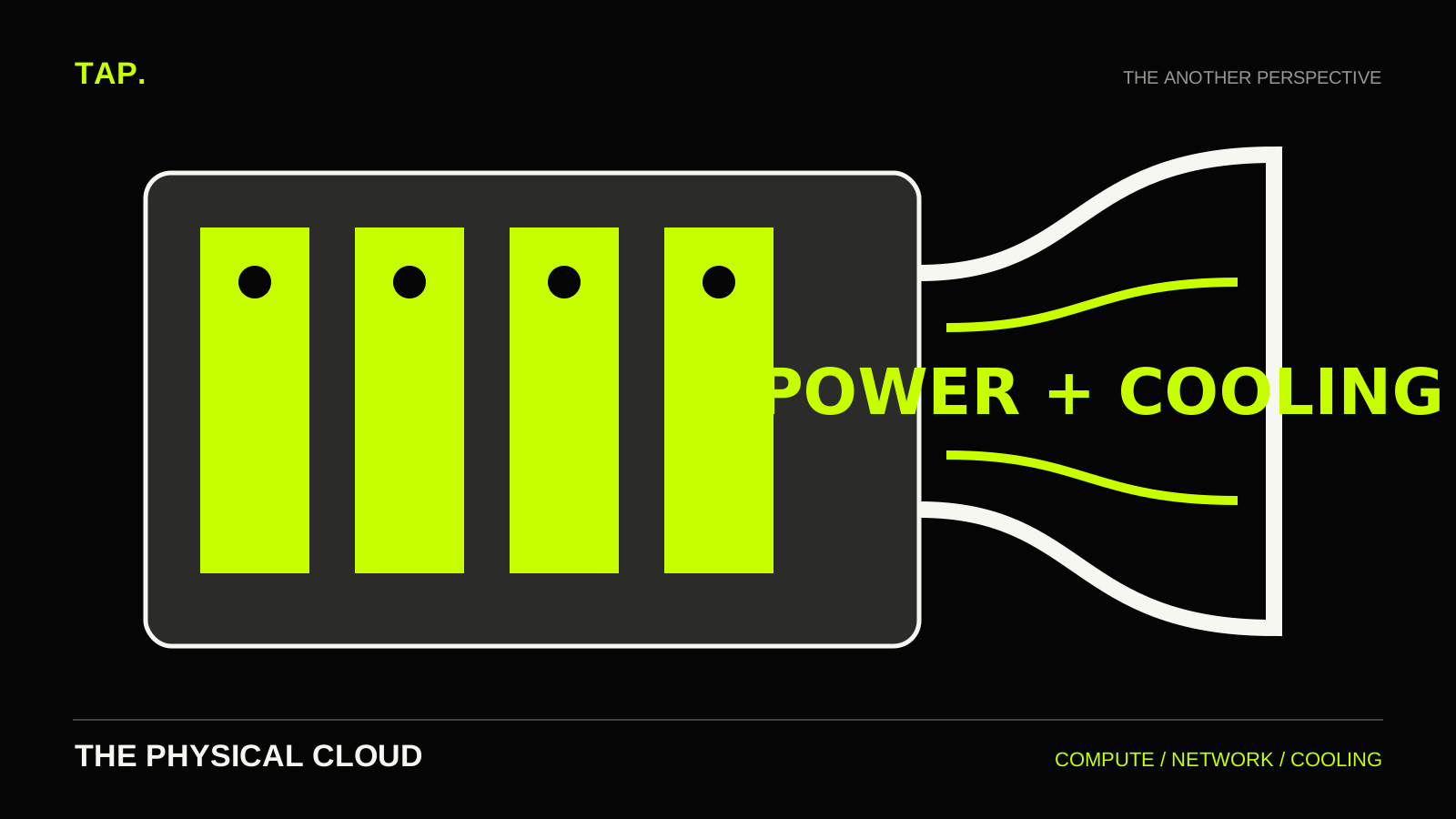
Fig. — The model sits inside an energy system.
A normal web request can be cheap. A modern AI request can involve billions of mathematical operations across specialized chips.
Multiply that by millions of users, then add training, storage, networking and cooling, and the data center starts to look less like an office building and more like an industrial facility.
The first load is compute
AI accelerators such as GPUs and custom AI chips are designed to perform huge numbers of calculations in parallel. That makes them useful for training and serving neural networks, but high performance comes with high power draw.
A single server can contain several accelerators. A large AI cluster contains thousands of them.
The second load is everything around the chip
The accelerator cannot work alone. It needs CPUs, memory, storage and extremely fast networking so machines can exchange data without waiting on one another.
Those components consume power too.
Then there is cooling. Electricity used by chips becomes heat, and that heat has to be removed continuously. Cooling equipment, pumps, fans and chillers can add a significant second layer of energy use depending on the facility and climate.
Training is intense. Serving is persistent.
Training a frontier model creates a highly visible burst of computing demand. But once a model becomes a product, inference can become the larger long-term workload because the service has to respond every time a user asks a question, generates an image, analyzes a file or runs an agent.
A popular model can therefore create steady demand rather than a one-time spike.
Why electricity demand is showing up in national forecasts
Reuters reported that the U.S. Energy Information Administration expects American power consumption to reach new records in 2026 and again in 2027, with data centers dedicated to AI and cryptocurrency among the major drivers.
That growth is large enough to affect wholesale power prices and regional planning.
The pressure is especially visible in markets such as PJM, where large clusters of data centers compete with existing homes and businesses for grid capacity.
Why companies sign energy deals years in advance
Building more servers is fast compared with building new power plants and transmission lines.
That mismatch creates a planning problem. A technology company may know it wants a large new computing campus before the local grid has enough spare capacity to serve it.
Long-term contracts with generators can help solve part of that problem. Google's 2026 agreement with Constellation Energy, for example, covers 3,590 MW of power and includes additional nuclear capacity.
Does every AI query have the same energy cost?
No.
The energy used depends on the model, hardware, size of the request, number of generated tokens, data-center efficiency, cooling method and electricity mix.
That is why simple viral claims such as 'one AI question uses exactly X times more power than one search' should be treated carefully unless the underlying assumptions are clear.
The important shift
For most of the internet era, computing companies could treat electricity as a utility bill.
At AI scale, electricity becomes a strategic input. Companies now negotiate directly with power producers, invest in generation, redesign data centers around grid constraints and plan capacity years ahead.
The AI cloud is still made of physical machines. Those machines need power every second they are useful.